Year 7 – 9
Religious Education

Key Stage: KS3
Curiosity, empathy and reflection lie at the heart of Religious Education. Students explore life’s big questions through diverse religions, philosophies and worldviews, developing understanding of themselves, others and the societies they live in. Through open dialogue and critical enquiry, they learn to think deeply, act compassionately and respect difference in all its forms.
Through Religious Education, students learn about the major world faiths and examine how belief systems have shaped cultures, societies and moral frameworks throughout history.
Lessons encourage respect, empathy and critical enquiry, allowing students to deepen their understanding of the diverse world in which they live. Alongside the major world religions, students explore emerging theological and spiritual movements, encouraging them to view religion as dynamic and responsive to modern life.
Students are taught to consider a range of religious and non-religious perspectives when exploring ethical and philosophical questions relevant to contemporary society, from human rights and social justice to environmental and moral decision-making.
We place strong emphasis on discussion, critical thinking and reflection. Students are encouraged to explain their ideas, challenge assumptions, evaluate different viewpoints and form their own justified conclusions.
This approach prepares students not only for academic success but also for life as thoughtful, open-minded and respectful citizens, capable of contributing positively to an increasingly diverse and globalised society.
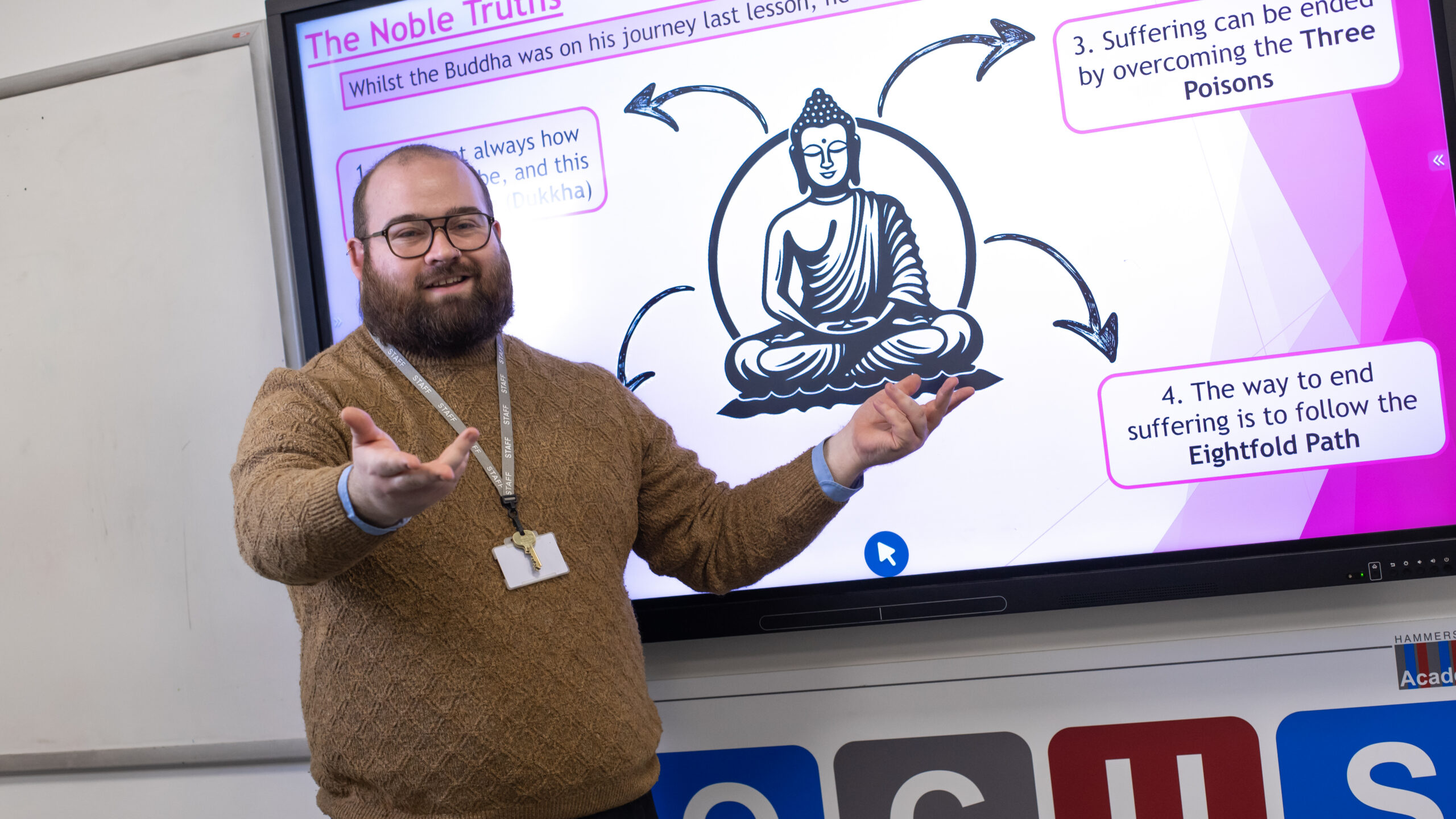
Our Key Stage 3 RE curriculum explores Judaism, Hinduism, Buddhism and Sikhism, alongside the growing spiritual movements of Wicca and Taoism. Including non-normative traditions broadens students’ perspectives, challenges stereotypes and builds religious literacy.
Wicca introduces students to nature-based spirituality and gender-inclusive practices, while Taoism presents Eastern philosophies on balance and harmony. Studying these alongside major world religions helps students appreciate the many ways humans seek meaning, purpose and connection in their lives.
Year-by-Year Curriculum
Year 7
Students begin their journey by studying the foundations of several major world religions and exploring less conventional belief systems to broaden their worldview.
Modules include:
- Judaism (Module 1)
- Hinduism (Module 2)
- Buddhism (Module 3)
- Sikhism (Module 4)
- Wicca and Taoism (Module 5)
- End of Year Revision (Module 6)
This year lays the groundwork for understanding core beliefs, sacred texts, places of worship and moral principles across faiths.
Year 8
Students study Christianity and Islam in depth, developing a comparative understanding of theology, practice and social impact. They also explore religion in relation to human rights and social justice.
Modules include:
- Christianity – Beliefs and Teachings (Modules 1 & 2)
- Islam – Beliefs and Teachings (Modules 3 & 4)
- Religion, Human Rights and Social Justice (Modules 5 & 6)
Lessons encourage students to analyse how faith informs moral decision-making and community action, while building confidence in discussion and debate.
Year 9
Students focus on the practical expressions of faith and the application of belief to contemporary ethical issues.
Modules include:
- Christianity – Practices (Modules 1 & 2)
- Islam – Practices (Modules 3 & 4)
- Religion and Life (Modules 5 & 6)
By the end of Year 9, students are able to reflect on complex questions of morality and meaning, preparing them for GCSE Religious Studies and the broader moral challenges of modern life.
Skills Gained
- Critical thinking and analysis
- Debate and communication
- Empathy and respect for others
- Independent reflection on values and beliefs
- Ethical reasoning and open-mindedness
These skills support students in developing intellectual curiosity, emotional intelligence and cultural awareness, qualities that benefit them across all areas of learning and life.
Potential Careers
Religious Education develops transferable skills that are valued in a range of professions, including:
Law, Politics and Public Service | Education Journalism and Media | Social Work and Counselling | International Relations and Human Rights
Students learn to evaluate multiple perspectives, communicate with sensitivity and think deeply about global and ethical issues.