Year 10 – 11
Religious Education

Key Stage: KS4

Exam Board: AQA

Qualification Gained: GCSE Religious Education

Assessment Structure:
The AQA GCSE Religious Studies (Specification A) course is assessed through two written examinations, each lasting 1 hour 45 minutes:
- Paper 1: The Study of Religions (50%) – Focuses on Christianity and Islam, exploring key beliefs, teachings and practices.
- Paper 2: Thematic Studies (50%) – Covers ethical and philosophical issues across four key themes:
– Theme A: Relationships and Families
– Theme B: Religion and Life
– Theme D: Religion, Peace and Conflict
– Theme F: Religion, Human Rights and Social Justice
Assessment involves short and extended written responses, evaluating students’ understanding of religious, ethical and philosophical perspectives.
Religious Education inspires students to explore life’s big questions with curiosity, respect and critical thinking. Through the study of diverse religions, beliefs and worldviews, students develop a deep understanding of themselves and others.
Our aim is to nurture informed, compassionate and reflective citizens who can engage positively in a pluralistic society. RE at Hammersmith Academy helps students think critically about morality, identity, faith and society — empowering them to approach complex global issues with empathy, logic and open-mindedness.
Students study major world faiths and examine how belief systems shape society, culture and human experience. Alongside Christianity and Islam, students engage with a range of contemporary moral and philosophical issues, exploring religious and non-religious perspectives on life’s biggest questions.
Lessons focus on critical thinking, evaluation, and reasoned argument, encouraging students to articulate personal viewpoints supported by evidence and analysis. Through debates, discussions and scriptural study, students develop confidence in explaining and justifying their ideas while appreciating contrasting perspectives.
The Key Stage 4 Religious Studies curriculum follows the AQA Specification A, focusing on the in-depth study of Christianity, Islam and four thematic areas: Relationships and Families, Religion and Life, Religion, Peace and Conflict, and Religion, Human Rights and Social Justice.
Building on theological, ethical and sociological foundations established in Key Stage 3, this course refines students’ ability to engage with ethical dilemmas, social issues and questions of meaning. Students are encouraged to connect beliefs to modern-day applications, from environmental concerns to social equality and human rights.
Entering students for GCSE Religious Studies in Year 10 ensures a broad and balanced learning experience across Key Stage 4. This approach builds on strong prior knowledge while supporting the development of critical thinking, ethical reasoning and cultural understanding — key elements of the national curriculum. Early entry allows time in Year 11 for targeted support and enrichment opportunities, maintaining high standards and ensuring readiness for further study
Year-by-Year Curriculum
Year 10
Students begin formal GCSE study with the thematic units, developing skills in ethical reasoning and scriptural interpretation.
Modules include:
- Theme D – Religion, Peace and Conflict (Modules 1 & 2)
- Theme A – Religion, Relationships and Families (Modules 3 & 4)
- Final Exam Revision (Module 5)
- Introduction to Philosophical Thought (Module 6)
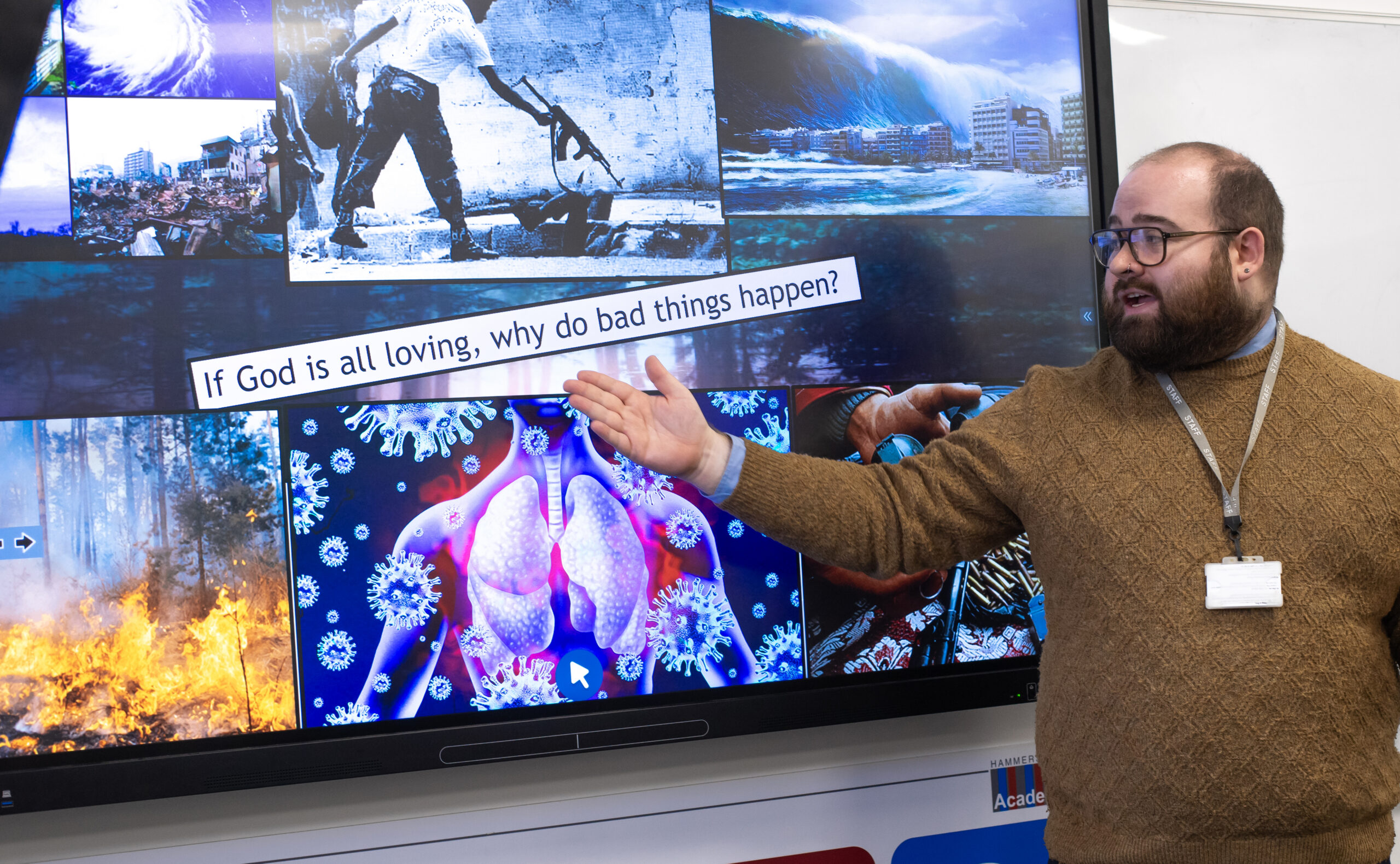
Throughout the year, students develop their ability to analyse and evaluate religious perspectives in relation to contemporary global challenges.
Year 11
Students revisit and consolidate key themes from Year 10 while engaging in targeted revision and wider philosophical enquiry to prepare for final exams. Lessons focus on deepening understanding, strengthening argumentation and refining essay-writing technique.
Skills Gained
- Ethical reasoning and moral evaluation
- Critical analysis of religious and philosophical texts
- Debate and communication
- Empathy and cultural literacy
- Personal reflection and independent thought
These skills prepare students to understand diverse perspectives, make reasoned judgments and contribute thoughtfully to discussions about global and moral issues.
Potential Careers & Progression
GCSE Religious Education provides an excellent foundation for:
A-Level Religious Studies, Philosophy or Sociology | A-Level Politics or Psychology | BTEC and AAQ pathways in Humanities and Social Sciences
Careers linked to RE include law, politics, journalism, education, counselling, social work and international development. The ability to evaluate ideas and communicate with empathy is valued in every sector.