Year 7 – 9
Science

Key Stage: KS3
Science sparks curiosity and empowers students to make sense of the world around them. Our vision is to cultivate confident and passionate learners who can apply the big ideas of science in real-life contexts and developing strong scientific literacy, critical thinking and a lifelong love of discovery.
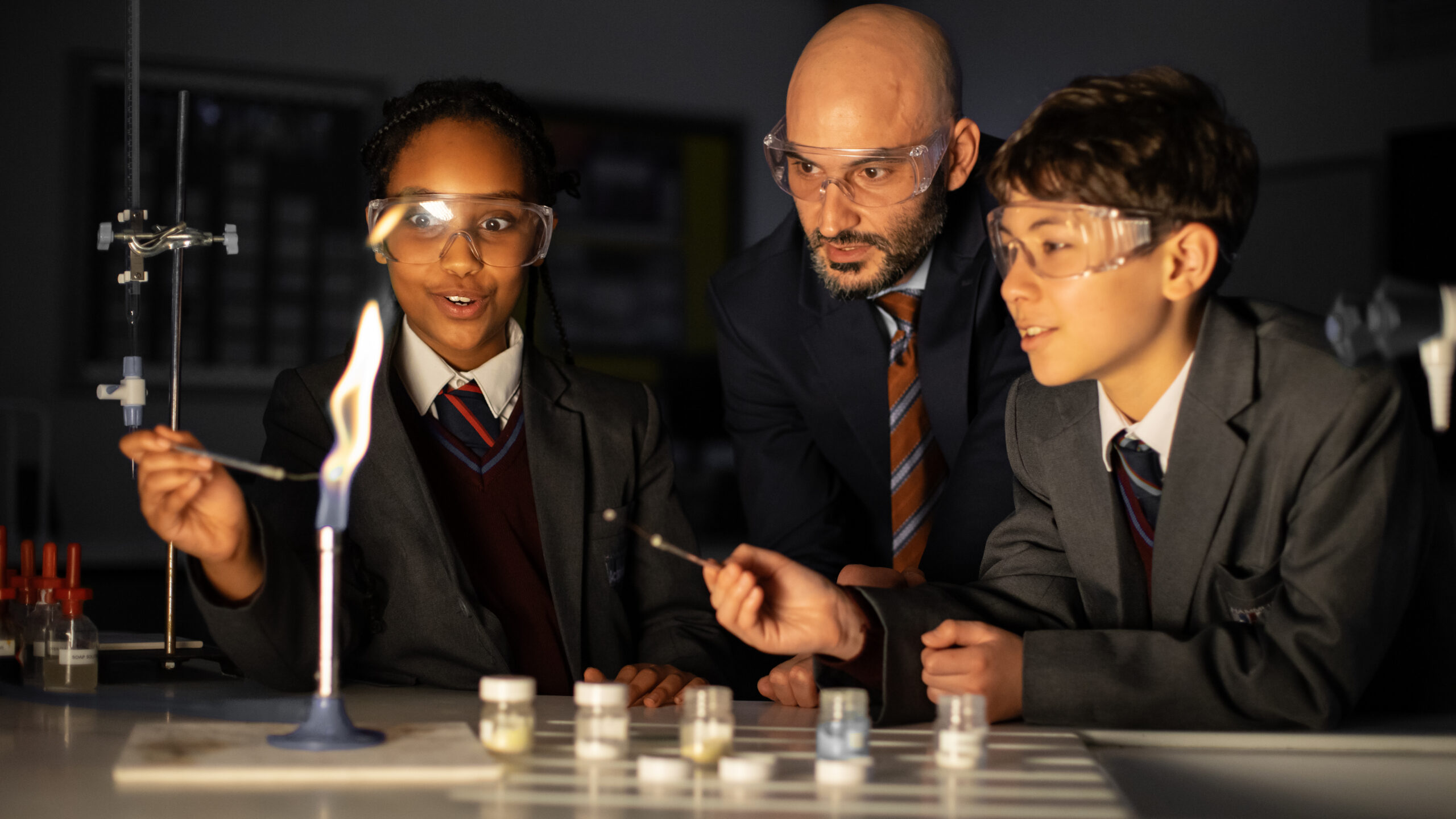
Our Science curriculum is built on a dynamic spiral model that promotes deep understanding through retrieval practice, practical work and synoptic links across topics. Students develop essential scientific skills and literacy through engaging lessons that encourage experimentation, analysis and evaluation.
Learning is underpinned by three key principles:
- Working scientifically, developing curiosity through questioning, observation and experimentation.
- Inclusive teaching, ensuring that all learners, including those with SEND, are supported through targeted interventions and accessible resources.
- High expectations and reflective practice, strengthened by regular feedback, assessment for learning and a strong classroom culture.
Through hands-on investigations and guided discovery, students learn to plan, carry out, analyse and evaluate scientific work. Literacy, numeracy and data handling are woven throughout the curriculum, helping students communicate findings effectively and apply mathematical understanding in a scientific context.
At Key Stage 3, students are introduced to the big ideas of science across biology, chemistry and physics, building on prior knowledge from Key Stage 2. The curriculum gradually moves from concrete concepts to abstract thinking, revisiting key ideas through practical and theoretical work to ensure lasting understanding.Students are explicitly taught scientific writing and the mathematical skills needed to interpret data, use equations and represent findings graphically. By building these foundations early, students are well prepared for the analytical and investigative demands of GCSE Science.
Year-by-Year Curriculum
Year 7
Students begin by exploring the building blocks of science, from the particle model of matter to cells, forces and energy. Practical work introduces key equipment, lab safety and scientific methods.
Modules include:
- Particles & Separating Mixtures (Module 1)
- Cells & Forces (Module 2)
- Rocks, Reproduction & Pressure (Module 3)
- Elements & Chemical Reactions (Module 4)
- Chemical Reactions & Digestion (Module 5)
- Energy & Ecology (Module 6)
Students learn to plan and conduct experiments, analyse results and communicate conclusions using scientific vocabulary.
Year 8
Students extend their knowledge into more complex systems, linking topics across biology, chemistry and physics while developing precision in experimental work.
Modules include:
- Density, Light & Acids and Alkalis (Module 1)
- Bioenergetics & Electricity (Module 2)
- Magnets, Resources and Climate & Speed (Module 3)
- Inheritance & Moments (Module 4)
- Reactivity & Heating (Module 5)
- Springs and Sound & Physiology (Module 6)
Lessons emphasise analysis, accuracy and the ability to make and test predictions using evidence.
Year 9
Students consolidate prior knowledge and begin bridging to GCSE Science through deeper conceptual understanding and more sophisticated practical work.
Modules include:
- Forces Part 1 – Motion, Cell Biology, Conductivity & Efficiency, Chemistry of Atmosphere (Module 1)
- Particle Model and Rates, Introduction to Digestion, Longitudinal (Module 2)
- Energy Changes, Circulation, Chemical Analysis & Water Cycle (Module 3)
- Current and Potential Difference & Cell Division, Active Transport, Microscopes & Forces Part 2 – Gravity (Module 4)
- Electricity Part 2 – Current, Potential Difference, Resistance & Photosynthesis and Communities, Atoms Introduction (Module 5)
- Human Defence and Human Impact on Environment, Forces Part 3 – Springs and Moments & Homeostasis Part 1 (Module 6)
Students apply their understanding to plan and evaluate investigations, interpret complex data and explain phenomena using scientific models.
Skills Gained
- Scientific enquiry and experimentation
- Critical thinking and analysis
- Data handling, numeracy and graphing
- Communication and report writing
- Problem-solving and evidence-based reasoning
These skills build confident learners who can apply science to real-world contexts and approach new challenges with curiosity and rigour.
Partnerships & Enrichment
Students benefit from inspiring experiences beyond the classroom through partnerships and visits that make science real and relevant.
Key partners and opportunities include:
- Wellcome Collection
- Science Museum
- St Paul’s Girls’ School
- West London Partnership
- Up Learn
These collaborations provide students with insight into scientific research, innovation and discovery in action.





Potential Careers
A strong foundation in science prepares students for diverse career pathways, including:
Medicine and Healthcare | Engineering and Technology | Environmental Science | Research and Data Analysis | Education and Science Communication
Science fosters analytical thinking, resilience and precision, qualities valued across academic, technical and professional fields.