Year 10 – 11
History

Key Stage: KS4

Exam Board: AQA

Qualification Gained: GCSE History

Assessment breakdown:
The AQA GCSE History course is assessed through two written examinations:
- Paper 1: Understanding the Modern World (50%) – Students study Germany, 1890–1945: Democracy and Dictatorship and Conflict and Tension: The Interwar Years, 1918–1939.
- Paper 2: Shaping the Nation (50%) – Covers Health and the People: c1000 to the Present Day and Elizabethan England, c1568–1603.
Each paper assesses knowledge, understanding, analysis, and evaluation of historical sources and interpretations, encouraging students to think and write like historians.
History at Hammersmith Academy aims to develop a love of learning and ignite students’ curiosity about the past through engaging and relevant topics. Our vision is to guide students towards the two key outcomes of studying History — understanding where they have come from and where they could go — and to equip them to create and defend opinions based on a wide range of sources, interpretations and evidence.
At Hammersmith Academy, we deliver a culturally rich, contextually relevant and high-skilled History curriculum designed to ensure that, by the end of Key Stage 4, students can articulate, explain and debate how the history of the UK and the wider world has shaped their lives today.
Students build a strong grasp of key historical concepts — including cause and consequence, change and continuity, and similarity and difference — and apply these when analysing diverse time periods and societies. By developing these conceptual skills, students learn to think critically, assess significance and form reasoned, evidence-based arguments.
From the outset, students are immersed in the process of ‘being a historian’, engaging with historical sources and interpretations to investigate enquiry-based questions rather than simply memorising content. Lessons challenge students to make connections across different eras and to evaluate multiple perspectives, building intellectual curiosity and independence.
The Key Stage 4 curriculum follows the AQA specification, with module choices carefully selected for their relevance, interest and interconnectivity.
For Paper 1, students study Conflict and Tension in the Interwar Years (1918–1939), exploring global diplomacy, the impact of appeasement and the creation of international peacekeeping organisations. They also examine Germany, 1890–1945, tracing the rise and fall of democracy, dictatorship and social change in modern Europe.
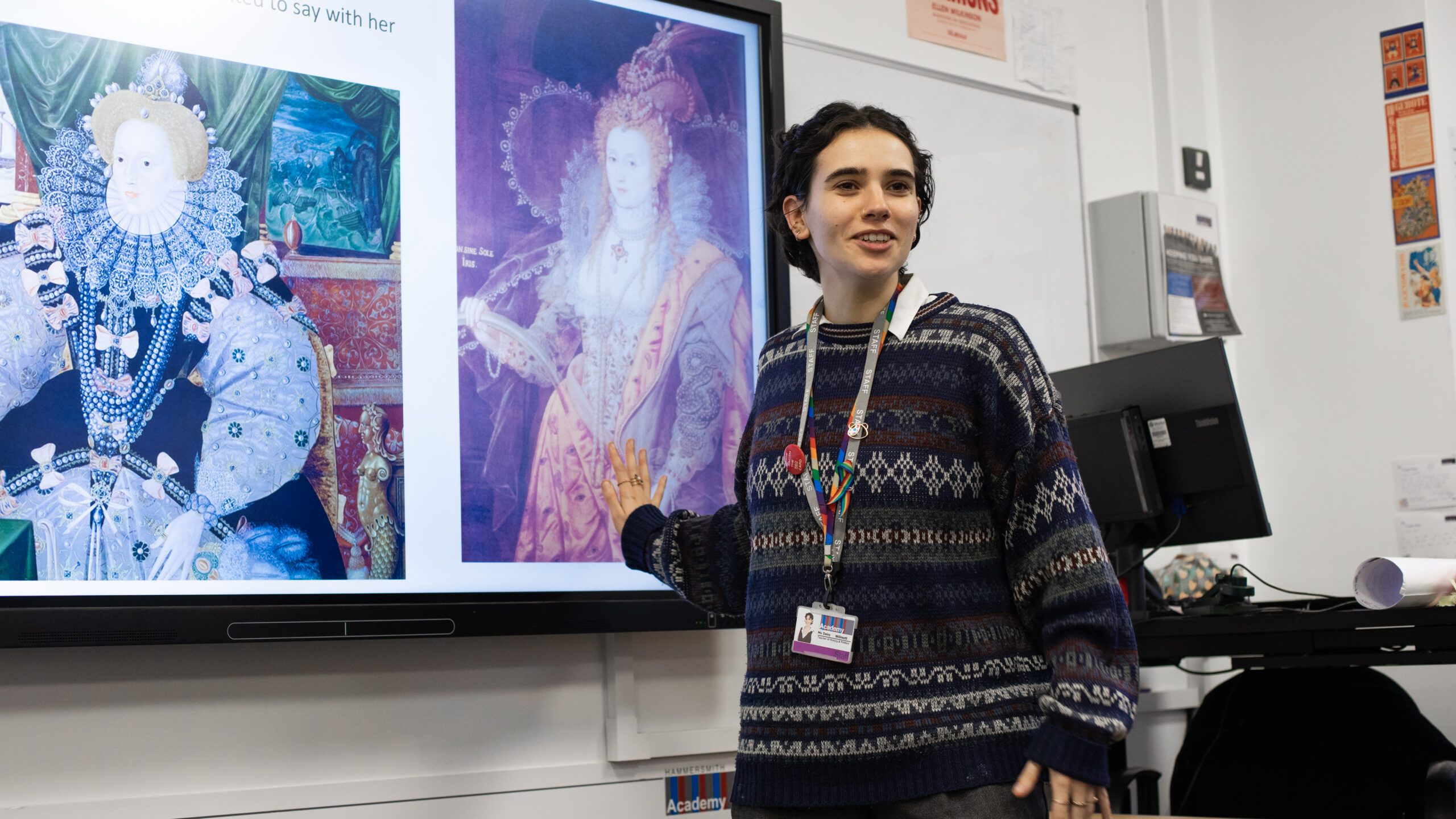
For Paper 2, students study Health and the People, which places contemporary debates such as the COVID-19 pandemic and the NHS into a historical context, alongside Elizabethan England, a module that highlights leadership, gender and social transformation in shaping modern Britain.
Together, these modules provide students with a broad and interconnected understanding of historical developments — encouraging empathy, reflection and critical analysis.
Year-by-Year Curriculum
Year 10
Students begin with the study of Elizabethan England before exploring Germany’s political and social transformation and the evolution of medicine and public health.
Modules include:
- Elizabethan Politics and Social Life (Module 1)
- Elizabeth – Troubles at Home and Abroad (Module 2)
- Germany – Rise of Democracy (Module 3)
- Experience of Germans under the Nazis (Module 4)
- Medieval and Renaissance Healthcare (Module 5)
- 19th Century and Modern Healthcare (Module 6)
Through these units, students gain insight into political decision-making, social change, and the lives of ordinary people in different eras.
Year 11
Students focus on global conflict, international relations and historical synthesis, building towards final exam readiness.
Modules include:
- Conflict and Tension: Peace and the League of Nations (Module 1)
- Conflict and Tension – The Road to War (Module 2)
- Health and the People Revision (Module 3)
- Elizabethan England (Module 4)
- Paper 1 Preparation (Module 5)
- Study Leave (Module 6)
Throughout both years, students strengthen their comprehension, analysis and evaluative writing skills, developing mastery of exam technique and historical argument.
Skills Gained
- Critical analysis and evaluation of sources
- Evidence-based reasoning and interpretation
- Extended writing and essay planning
- Understanding of continuity, change and causation
- Communication and argumentation
- Empathy and cultural awareness
These skills foster independent thought and prepare students for advanced study and a wide range of professional pathways.
Partnerships & Enrichment
Students enrich their studies through visits and partnerships that bring the past to life, including trips to Hampton Court Palace and the Imperial War Museum. These experiences encourage curiosity, deepen contextual understanding and support engagement with real-world history beyond the classroom.

Potential Careers & Progression
GCSE History provides a strong foundation for:
A-Level History, Politics or Sociology | Law, International Relations or Economics pathways | Humanities and Social Science routes
Career opportunities include journalism, law, education, public service, archaeology, heritage and business. History develops analytical, research and writing skills that are valuable across all sectors.