Year 12 – 13
Computer Science

Key Stage: KS5

Exam Board: OCR

Qualification Gained: A Level Computer Science

Assessment Breakdown: A-Level Computer Science (OCR) is assessed through:
- Paper 1: Computer Systems (40%)
- Paper 2: Algorithms and Programming (40%)
- NEA: Programming Project (20%)

Entry Requirements:
Eight or more GCSEs at grades 9–4 including:
- Grade 5 in GCSE English Language
- Grade 6 in GCSE Mathematics
- Grade 6 in GCSE Computer Science (if studied at GCSE)
We aim to foster computational thinking, creativity and enjoyment, enabling students to understand and shape the world through problem-solving, digital literacy and technological innovation.
A-Level Computer Science at Hammersmith Academy empowers students to become analytical, creative and adaptable thinkers in a world increasingly shaped by technology. Through an engaging and intellectually rigorous curriculum, learners develop deep computational understanding and practical programming skills, while gaining insight into the inner workings of natural and artificial systems.
Rooted in computational thinking, the course develops student competency in:
- Abstraction and decomposition
- Logical reasoning and algorithm design
- Data structures and data representation
- Software development and rigorous problem-solving
The curriculum is divided into three key components:
- Computer Systems – covering hardware, software, CPU architecture, memory, storage, data representation, networking and legal/ethical issues
- Algorithms and Programming – studying computational methods, problem decomposition, recursion, OOP, array manipulation, algorithm efficiency and searching/sorting techniques
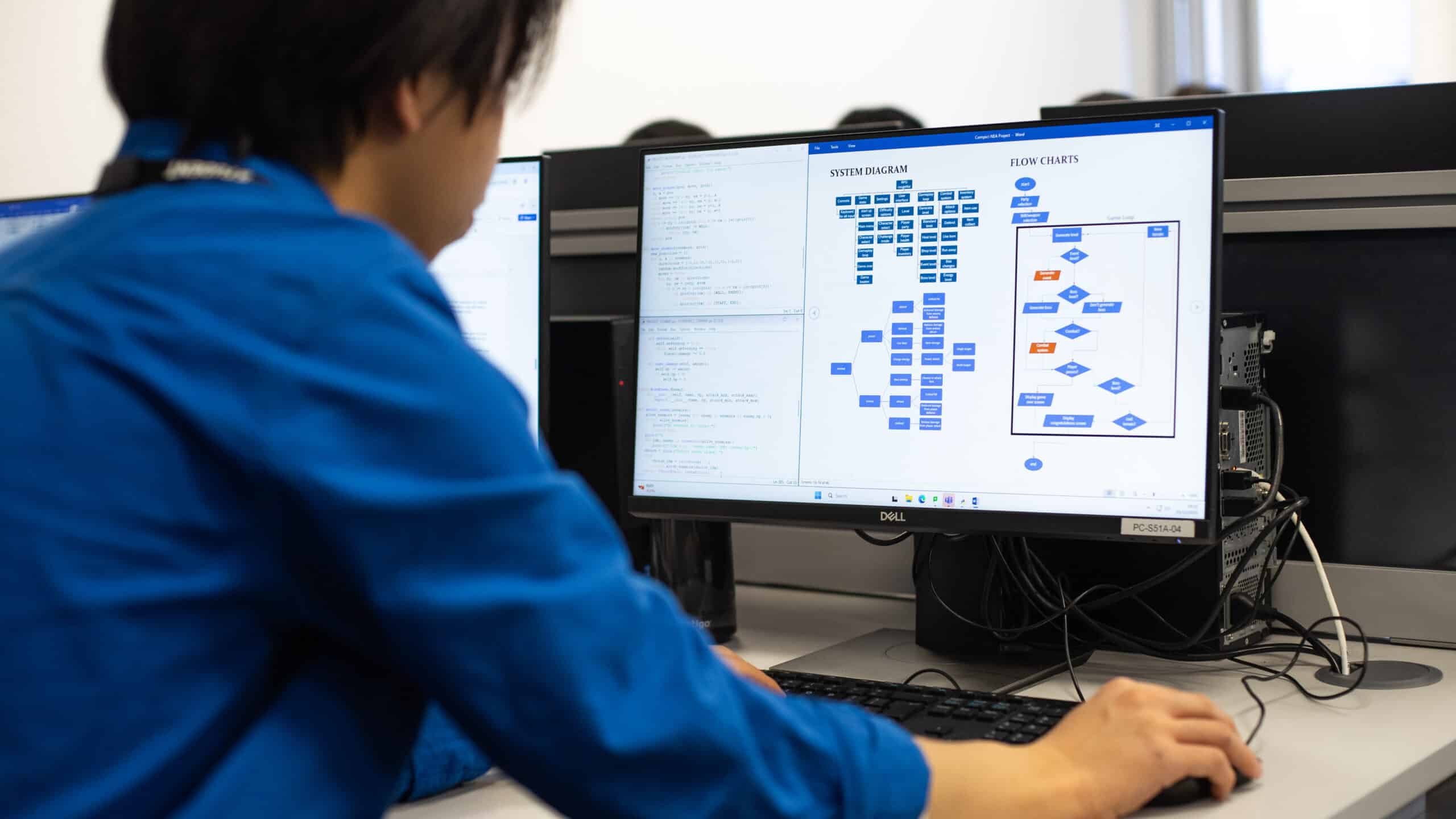
- Programming Project (NEA) – a substantial independent project where students identify a real-world problem and design, develop, test and evaluate a software solution
This practical project fosters creativity, deepens technical proficiency and develops professional skills in project management, iterative development and documentation—mirroring real industry practice.
Across both years, students develop confidence in writing high-quality, well-structured code, using programming to explore real-world challenges and applying computational methods to plan, build and refine solutions. The course prepares students for a wide range of STEM pathways, including computing, engineering, data science and software development.
Year-by-Year Curriculum
Year 12
Module 1: Computer Architecture & Computational Thinking Foundations
CPU architecture, Boolean logic, binary systems, problem decomposition.
Module 2: Systems Software to OOP — From Assembly to Design
Operating systems, low-level languages, introduction to object-oriented programming.
Module 3: Data, Databases & Data Structures
SQL fundamentals, relational databases, arrays, stacks, queues and trees.
Module 4: Networks & Algorithmic Efficiency
Protocols, topologies, network security; analysing algorithm complexity.
Module 5: Web Engineering & Data Representation
HTML, CSS, data encoding, error checking and transmission.
Module 6: Computing in Society, Revision & NEA Consolidation
Ethical, cultural and legal implications; early NEA planning.
Year 13
Module 1: Systems & Algorithmic Foundations with NEA Scoping
Advanced system-level concepts; planning and feasibility for NEA.
Module 2: Exchanging Data, Robust Programming & NEA Build
Cybersecurity, encryption, APIs; iterative NEA development.
Module 3: Synoptic Systems, Advanced Algorithms & NEA Implementation Complete
Advanced algorithm design, heuristics, computational strategies.
Module 4: Exam Technique Sprint & NEA Finalisation
Refining code, documentation and evaluation; exam technique.
Module 5: Papers 1 & 2 Intensive — High-Yield Practice
Timed practice, synoptic revision and mastery of computational logic.
Skills Gained
Students develop highly transferable and industry-relevant skills, including:
- Computational and algorithmic thinking
- Advanced programming skills
- Problem-solving and logical reasoning
- Data analysis and abstraction
- Understanding of system architecture and networks
- Project management and iterative development
- Technical documentation and communication
These skills prepare learners for university-level computing and a wide range of technical and analytical roles.
Partnerships & Enrichment
Students benefit from opportunities such as:
- Coding clubs and competitions
- AI and robotics enrichment
- University masterclasses
- Digital skills workshops
- Industry guest speakers
- Access to NEA mentoring and project clinics
These experiences enhance digital confidence and support students in exploring emerging technologies.
Potential Careers
A-Level Computer Science supports progression into fields such as:
Software Developer | App Developer | Data Analyst / Data Scientist | Game Designer / Game Developer | AI & Robotics Engineer | Systems Architect | Cybersecurity Specialist | UX/UI Designer | Web Developer | Digital Marketing & Tech Specialist
Computing underpins almost every industry, making career pathways vast and highly future-proof.