Year 12 – 13
Biology

Key Stage: KS5

Exam Board: AQA

Qualification Gained: A Level Biology

Assessment Breakdown:
- Three written examination papers (covering content from both years)
- A separate practical endorsement demonstrating competency across required practicals

Entry Requirements:
Eight or more GCSEs at grades 9–4 including:
- Minimum Grade 6 in GCSE Biology or 6/6 in Combined Science or 5/5/6 in Triple Science (with at least a 6 in Biology)
- Grade 6 in GCSE Mathematics
- Grade 6 in GCSE English Language
We aim to develop confident, curious biologists who understand how Biology shapes the world around us, while fostering critical thinking, problem-solving and analytical skills through engaging, rigorous learning.
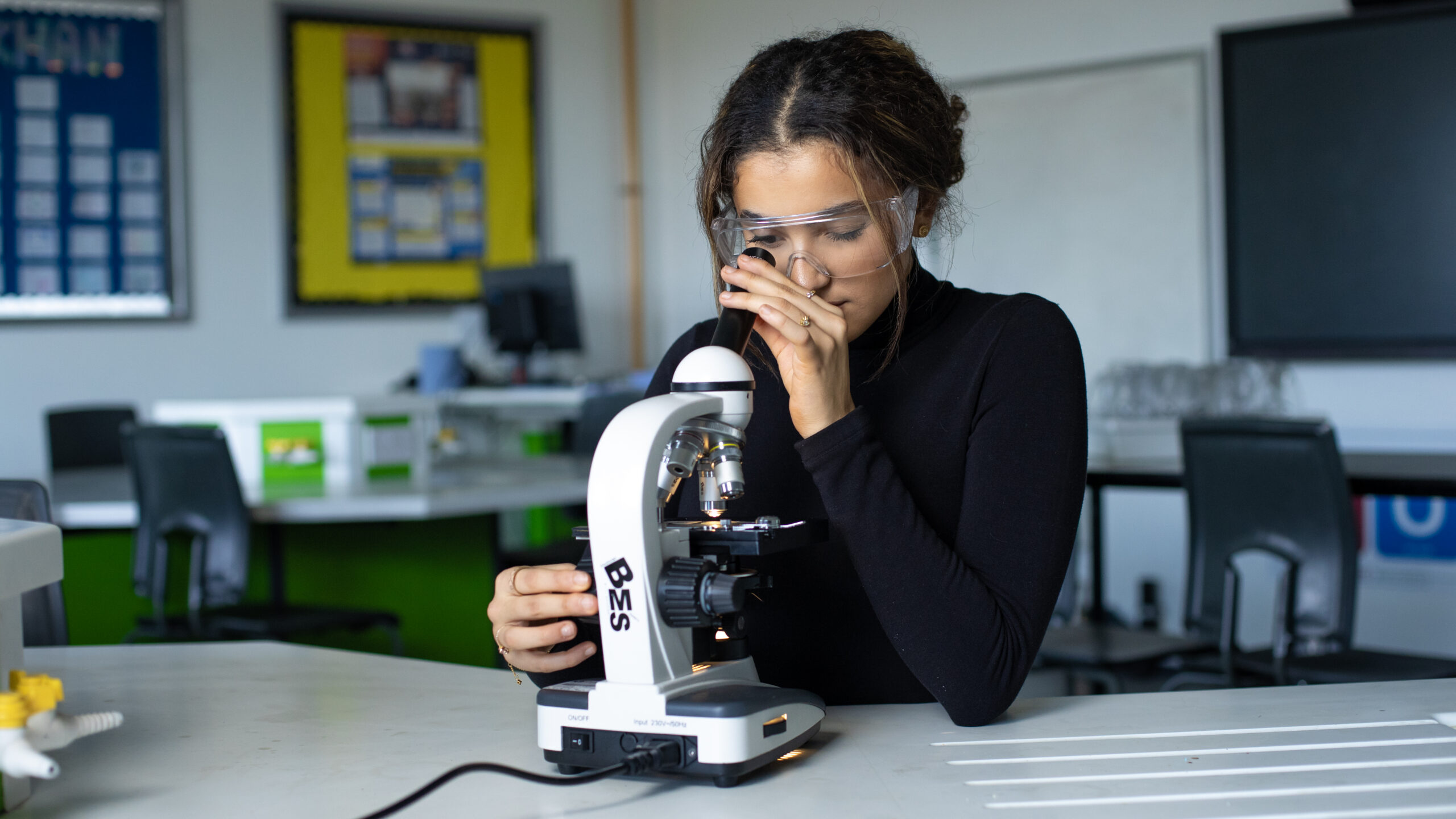
A-Level Biology at Hammersmith Academy nurtures students into resilient, independent thinkers with a deep curiosity for the living world. Through a rich combination of theoretical study, practical investigations and real-world applications, students explore the complexity and diversity of biological systems from molecules to ecosystems.
Our curriculum emphasises:
- Critical thinking and conceptual understanding
- Mathematical and statistical application in Biology
- Core practical competency, in alignment with AQA’s practical endorsement
- Independent learning, supported by guided practice and modelling
- Scientific communication, enabling students to articulate complex ideas fluently
Students apply “working scientifically” principles throughout the course, learning to plan, carry out, analyse and evaluate investigations. These skills are essential preparation for university-level science.
Educational visits, STEM enrichment opportunities, and exposure to current biological research help students connect classroom learning to careers in healthcare, life sciences, environmental science, biotechnology and beyond.
A-Level Biology is designed to challenge, inspire and prepare students for academic success and future scientific study.
Course Structure
A-Level Biology is assessed through:
- Three written examination papers (covering content from both years)
- A separate practical endorsement demonstrating competency across required practicals
Students study key topic areas including biological molecules, cells, genetics, energy transfers, homeostasis, ecology, evolution and gene expression. Mathematical and statistical skills are integrated throughout.
Year-by-Year Curriculum
Year 12
Module 1: Biological Molecules and Cells
Foundational study of proteins, carbohydrates, lipids, enzymes and cellular ultrastructure.
Module 2: Biological Molecules 2 and Exchange in Plants
Transport systems, exchange surfaces and plant physiology.
Module 3: Membranes and Biodiversity
Transport across membranes, classification, biodiversity and adaptation.
Module 4: Immunity and Exchange in Animals and Digestion
Immune response, pathogens, gas exchange systems and digestive processes.
Module 5: Respiration (A-Level content) and Mass Transport in Animals
Respiration pathways, circulatory systems and transport mechanisms.
Module 6: Energy and Ecosystems and Photosynthesis (A-Level content)
Nutrient cycles, energy transfer, productivity and photochemical processes.
Year 13
Module 1: Organisms Respond to Changes in Their Environments
Neuronal communication, hormonal responses and behavioural adaptation.
Module 2: Homeostasis and Inherited Change
Feedback mechanisms, inheritance patterns, meiosis and genetic diversity.
Module 3: Populations, Ecosystems and Evolution & Control of Gene Expression (Part 1)
Population dynamics, ecological interactions, natural selection and gene regulation.
Module 4: Populations, Ecosystems and Evolution & Control of Gene Expression (Part 2)
Gene technologies, PCR, electrophoresis, recombinant DNA.
Module 5: Exam and Essay Preparation
Synoptic review, extended essay skills and targeted revision.
Skills Gained
Students develop a wide range of scientific and transferable skills, including:
- Planning, carrying out and evaluating scientific investigations
- Applying mathematical, statistical and problem-solving skills
- Analysing data from experiments and biological research
- Understanding and interpreting scientific evidence
- Explaining complex ideas using precise biological language
- Constructing structured, evaluative essays
- Independent research, practical competency and scientific accuracy
These skills are highly applicable across STEM pathways and academic disciplines.
Partnerships & Enrichment
Students benefit from a range of experiences that bring Biology to life, including:
- University lectures and STEM masterclasses
- Science Museum visits
- Biology research workshops
- Guest speakers from healthcare and scientific research sectors
- Access to extended reading and independent research through the Sixth Form Super Curriculum
Potential Careers
A-Level Biology provides an excellent foundation for careers such as:
Medicine & Dentistry | Veterinary Medicine | Biomedical Science | Pharmacy & Pharmacology | Physiotherapy & Sports Science | Ecology & Environmental Science | Research Science & Biotechnology | Education | Nursing & Healthcare Professions | Law (with a science specialism) | Engineering (bioengineering, chemical engineering)