Year 12 – 13
Psychology

Key Stage: KS5

Exam Board: AQA

Qualification Gained: A Level Psychology

Assessment Breakdown:
The AQA A Level Psychology course is assessed through three written examinations, each worth 33.3% of the final grade:
- Paper 1: Introductory Topics in Psychology – Covers Social Influence, Memory, Attachment, and Psychopathology.
- Paper 2: Psychology in Context – Includes Approaches in Psychology, Biopsychology, and Research Methods.
- Paper 3: Issues and Options in Psychology – Assesses Issues and Debates in Psychology and three optional topics (Relationships, Schizophrenia, and Aggression).

Entry Requirements: Students must have achieved eight or more GCSEs at grades 9–4, including a minimum Grade 6 in English Language and Mathematics, and either 6/6 in Combined Science or a Grade 6 in Biology.
Psychology at Hammersmith Academy fosters curiosity, empathy and critical thinking, helping students explore the complexities of human behaviour and mental processes. The course enables learners to understand themselves and others through the scientific study of the mind, while developing the analytical and evaluative skills needed for further study and the modern workplace.
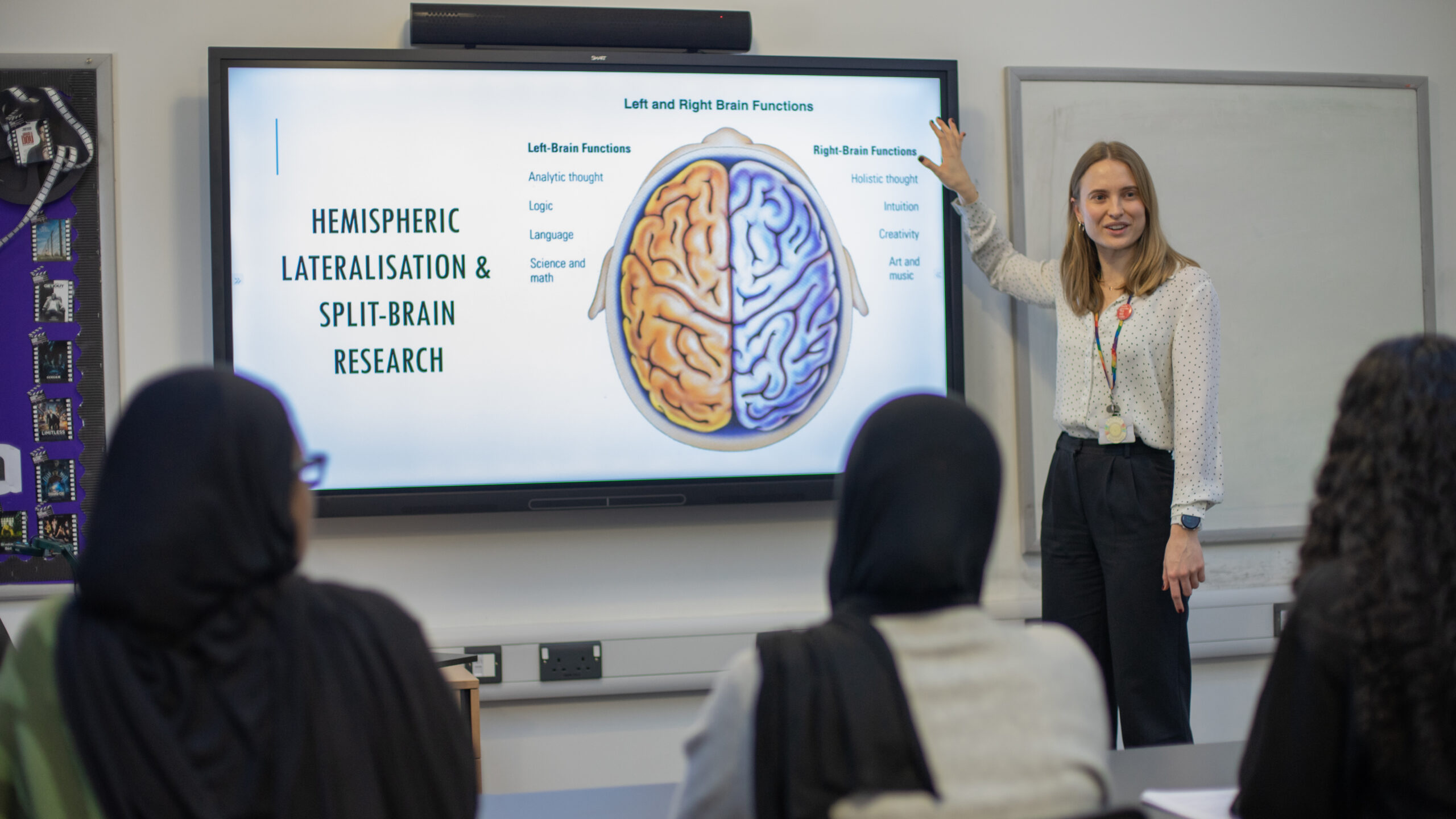
Psychology is the scientific study of the mind and behaviour, exploring how biological, cognitive, developmental and social factors shape individuals and influence society. The A-Level course provides a balanced combination of theory, research and application, allowing students to make meaningful connections between scientific understanding and everyday life.
Our curriculum is carefully sequenced to develop core knowledge, critical analysis and applied evaluation skills in line with the AQA specification. Students study the key perspectives of psychology — from the behavioural to the humanistic — and examine how psychological research helps us understand social behaviour, memory, development, and mental health.
In Year 12, students cover foundational content from Paper 1 and Paper 2, exploring Social Influence, Memory, Attachment, Approaches, Clinical Psychology, Biopsychology, and Research Methods. Lessons combine theory with applied learning, enabling students to connect psychological principles to real-world contexts such as education, health and social behaviour.
In Year 13, students build upon this foundation by studying advanced content from Paper 3. They explore Issues and Debates and optional topics such as Relationships, Schizophrenia, and Aggression, developing synoptic understanding and the ability to evaluate complex theories and evidence.
Research methods are embedded throughout both years. Students design and conduct small-scale investigations, analyse data, and interpret statistical findings. This practical approach strengthens both their scientific reasoning and their understanding of ethical, methodological and psychological principles.
Taught by passionate and experienced specialists, the course is designed to challenge and inspire. Through discussion, experimentation and essay-based analysis, students develop as independent thinkers capable of reasoned judgement and critical reflection — skills highly valued in higher education and professional fields.
Year-by-Year Curriculum
Year 12
Students explore the foundations of psychological theory, research and behaviour through a combination of analytical study and experimental investigation.
Modules include:
- Approaches, Research Methods (Module 1)
- Clinical Psychology and Mental Health & Research Methods (Modules 2–3)
- Memory, Attachment & Research Methods (Module 4)
- Memory, Biopsychology, Attachment & Social Influence (Module 5)
- Biopsychology & Social Influence (Module 6)
This year focuses on establishing key concepts, critical analysis and the ability to apply theory to contemporary examples.
Year 13
Students extend and consolidate their understanding of psychology through higher-level analysis, synoptic links and independent evaluation.
Modules include:
- Issues and Debates (Module 1)
- Schizophrenia & Relationships (Module 2)
- Relationships & Aggression (Module 3)
- Revision and Exam Preparation (Modules 4–5)
By the end of the course, students can confidently apply psychological theory to real-world contexts, evaluate complex arguments, and express ideas with academic precision.
Skills Gained
- Critical thinking and analysis
- Research design and data interpretation
- Essay writing and extended argument construction
- Communication and presentation
- Empathy and understanding of human behaviour
- Global and cultural awareness
These skills prepare students for higher education and careers that require problem-solving, people skills and analytical reasoning.
Partnerships & Enrichment
Students benefit from a variety of enrichment experiences that extend learning beyond the classroom, including visits and collaborations with:
- Freud Museum
- Wellcome Collection
- University Psychology Taster Days
- Science Museum
- Bethlem Royal Hospital
- Guest University Lectures and Seminars
These experiences help students connect psychological theory with real-world research, practice and professional settings.




Potential Careers & Progression
A Level Psychology provides an excellent foundation for:
- A Level and Degree courses in Psychology, Sociology, Criminology, or Education.
University and professional careers in:
- Therapy, Counselling and Clinical Psychology
- Occupational, Sports or Health Psychology
- Teaching and Educational Support
- Human Resources and Recruitment
- Research, Marketing and Social Policy
Psychology’s blend of science and humanity makes it one of the most versatile and employable A-Levels, opening pathways into both STEM.