Year 12 – 13
Spanish

Key Stage: KS5

Exam Board: AQA

Qualification Gained: A Level Spanish

Assessment Breakdown:
Assessment tasks are varied and cover listening, speaking, reading, and writing skills:
- Paper 1: Listening, Reading and Writing (50%) – Students respond to spoken and written texts and complete translation tasks.
- Paper 2: Writing (20%) – Involves essays on a literary text and a film studied during the course.
- Paper 3: Speaking (30%) – A discussion on one of the themes studied and a presentation based on an individual research project.

Entry Requirements: Students must have achieved eight or more GCSEs at grades 9–4, including a minimum Grade 7 in Spanish.
Spanish at Hammersmith Academy inspires inquisitiveness, confidence and a deep appreciation for language and culture. The course equips students to communicate fluently while developing critical awareness of the diverse societies that make up the Spanish-speaking world. By engaging with authentic materials, film, literature and debate, learners become open-minded linguists ready to connect with people and ideas across the globe.
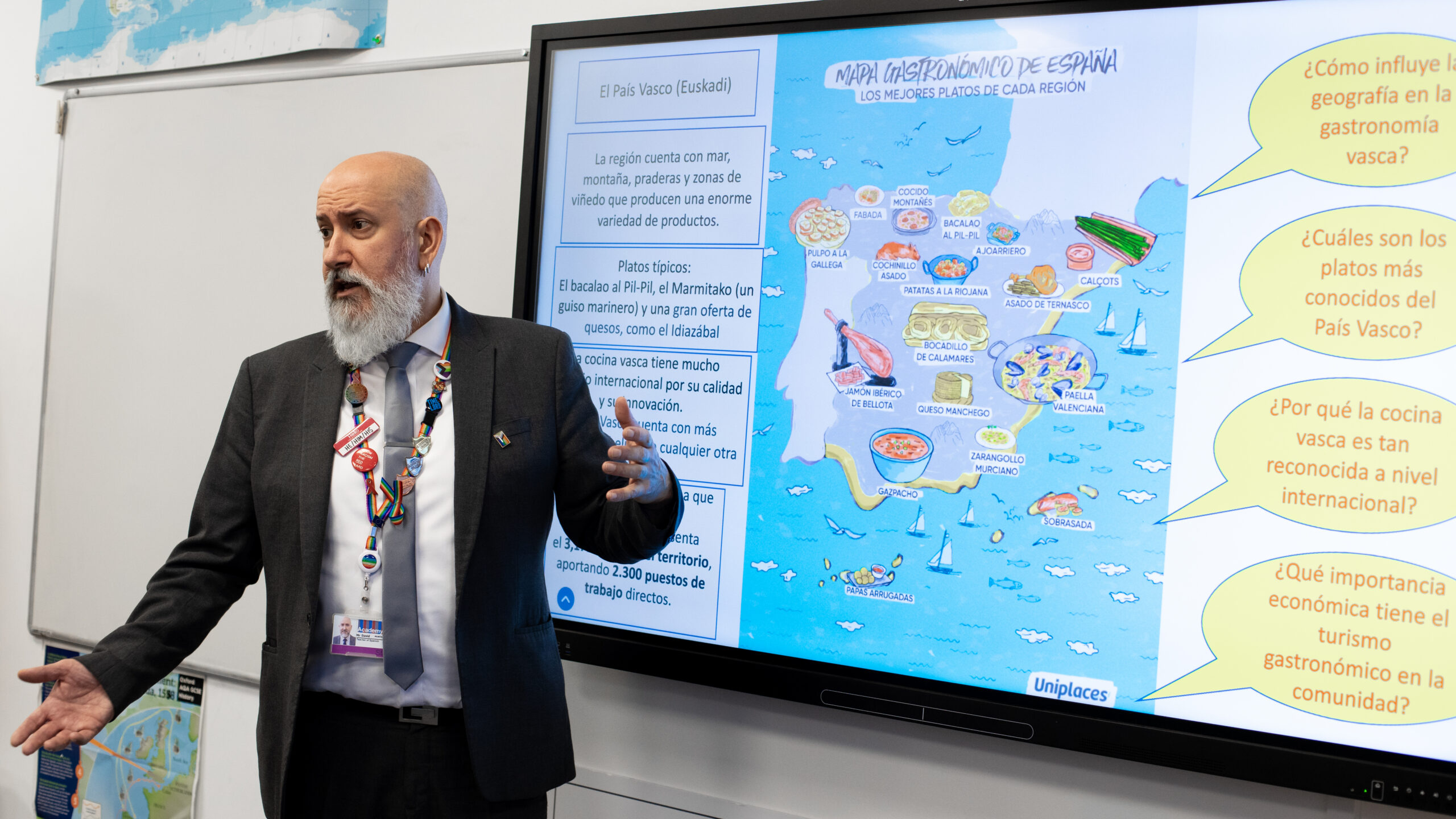
The A-Level Spanish curriculum is designed to build confident, culturally aware linguists who can communicate fluently and think critically about the Spanish-speaking world. Lessons are fully delivered in Spanish to ensure immersion, and students progressively develop listening, reading, writing and speaking skills through authentic and engaging study.
In Year 12, students bridge the gap between GCSE and A-Level by revisiting familiar themes while expanding vocabulary and grammatical range. The year begins with accessible topics that build fluency and accuracy before introducing more advanced cultural and linguistic content. By the end of the year, students can hold extended conversations, discuss cultural topics and interpret complex texts with growing confidence.
Students explore life in Spain and other Hispanic countries, studying social change, technology, equality and regional identity. They also analyse the acclaimed film El Laberinto del Fauno (Pan’s Labyrinth), gaining insight into Spanish history and society through film analysis and critical discussion. Homework tasks include independent research, interaction with authentic media (articles, podcasts, videos) and grammar consolidation — fostering autonomy and curiosity.
In Year 13, students extend their understanding through the study of La Casa de Bernarda Alba by Federico García Lorca, alongside themes of immigration, multiculturalism, and political change. They also prepare an Individual Research Project on a topic of personal interest related to Hispanic culture or current affairs. These elements allow students to express informed opinions and demonstrate intellectual independence.
The course culminates in the development of near-native linguistic control and the ability to communicate complex ideas clearly. Enrichment opportunities such as cultural trips, film screenings, and contact with native speakers connect classroom learning with real-world contexts, broadening students’ global awareness and intercultural competence.
Year-by-Year Curriculum
Year 12
Students consolidate grammar, extend vocabulary and deepen their cultural knowledge through diverse themes and authentic sources.
Modules include:
- Los Valores Tradicionales y Modernos + El Ciberespacio (Module 1)
- El Laberinto del Fauno + La Igualdad de los Sexos (Module 2)
- La Identidad Regional + La Influencia de los Ídolos (Module 3)
- La Identidad Regional + El Patrimonio Cultural (Modules 4–5)
- El Patrimonio Cultural + Revision (Module 6)
Year 13
Students refine fluency, critical analysis and independent research skills through advanced linguistic and cultural study.
Modules include:
- Jóvenes de Hoy + La Inmigración + La Casa de Bernarda Alba (Module 1)
- Monarquías y Dictaduras + La Inmigración + La Casa de Bernarda Alba (Module 2)
- Movimientos Populares + El Racismo (Module 3)
- La Convivencia + Revision and Practice (Module 4)
- Revision and Exam Practice (Module 5)
By the end of the course, students can interpret complex ideas, articulate opinions with fluency and confidence, and engage deeply with literature, film and cultural debates.
Skills Gained
- Communication and linguistic precision
- Listening, reading, writing and speaking fluency
- Translation and interpretation
- Critical and cultural analysis
- Research and presentation skills
- Independence and global awareness
These skills prepare students for university study and international careers requiring cultural sensitivity and advanced communication abilities.
Partnerships & Enrichment
Students immerse themselves in the Spanish language and culture through trips, exchanges and partnerships, including:
- Trip to Spain
- Academia Estudio
- Hampton School
- British Film Institute (BFI)
These experiences enhance linguistic confidence, cultural insight and a lifelong appreciation of Spanish-speaking cultures.


Potential Careers & Progression
A-Level Spanish provides an excellent foundation for:
University study in Modern Languages, International Relations or European Studies
Career pathways including:
Interpreter or Translator | Language Teacher or Academic Researcher | International Development or Diplomacy | Journalism, Marketing, Advertising or PR Business | Logistics or Finance roles with global focus
Fluency in Spanish — one of the world’s most widely spoken languages — opens global opportunities across education, media, commerce and international affairs.