Year 12 – 13
Media Studies

Key Stage: KS5

Exam Board: Eduqas

Qualification Gained: A Level Media Studies

Assessment Breakdown:
A-Level Media Studies is assessed through:
- Two written examination papers (Component 1 & Component 2)
- One Non-Exam Assessment (NEA) — a cross-media production responding to a brief set by Eduqas

Entry Requirements: Eight or more GCSEs at grades 9–4 including a minimum Grade 6 in GCSE English Language.
We aim to empower students to become critical, informed and engaged citizens who can effectively analyse and create media in a rapidly evolving world.
At Key Stage 5, students build on their prior understanding of media by engaging deeply with the four key frameworks: media language, representation, audiences and industries. These conceptual lenses are applied to a wide range of set texts across different sectors, enabling students to understand how meaning is constructed, communicated and interpreted within contemporary and historical media contexts.
The curriculum is spiral and cumulative, ensuring knowledge and skills are revisited, refined and expanded across the two years. Students analyse media products from film, television, advertising, radio, magazines, online platforms and video games, developing sophisticated critical perspectives and insight into wider cultural, social and political influences.
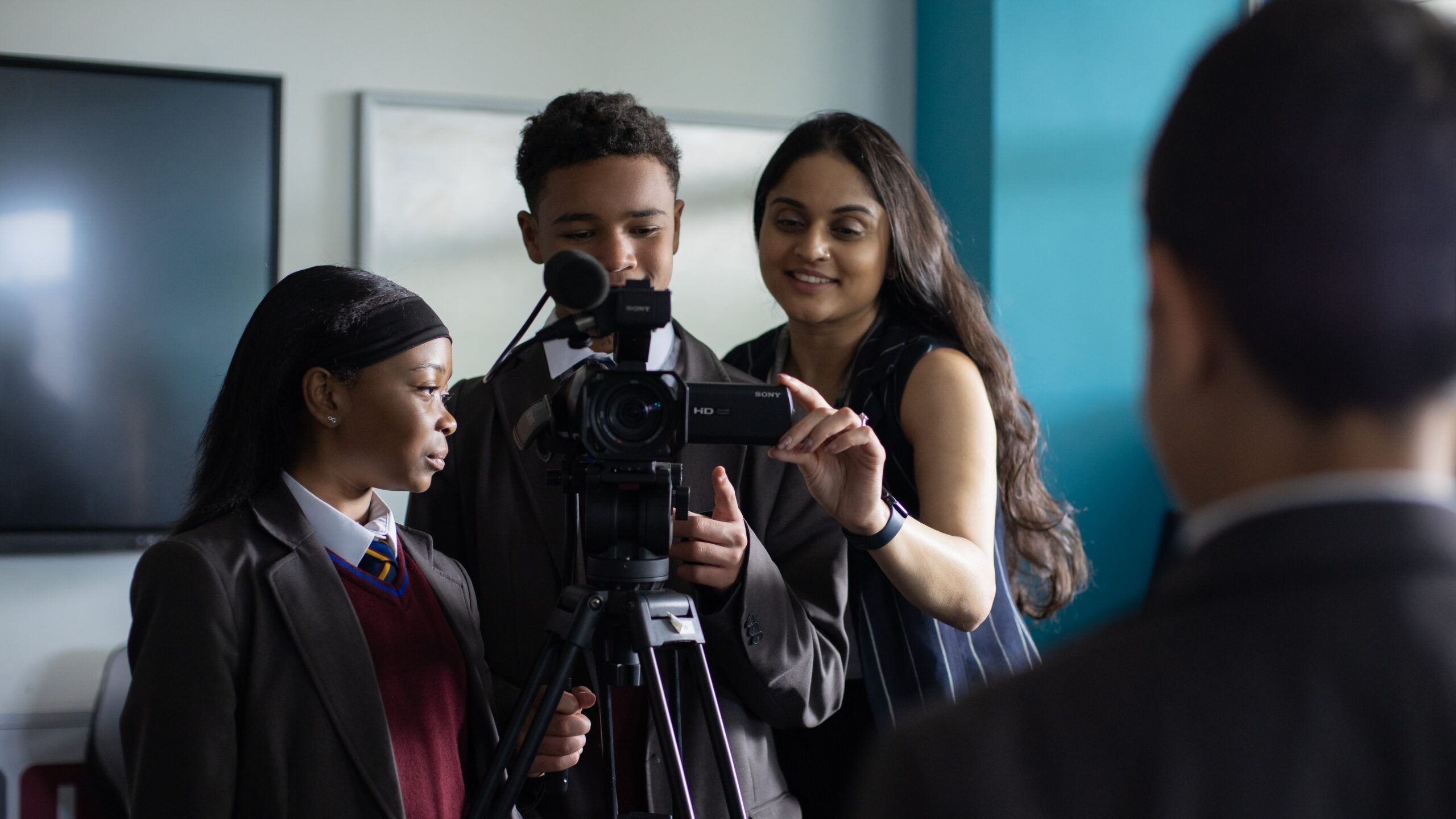
Practical production work is embedded throughout the course. Learners gain technical proficiency in digital editing, layout, sound design and media software, building confidence as creative practitioners. This culminates in the Non-Exam Assessment (NEA), where students independently plan, design and produce media products to a professional standard, demonstrating their ability to apply theory to purposeful creative work.
The course equips students with:
- Critical, analytical and evaluative skills
- Creative production, design and technical competencies
- Understanding of media industries and audiences
- Ability to apply theoretical perspectives and specialist terminology
- Awareness of media’s role in shaping culture and society
Course Structure
A-Level Media Studies is assessed through:
- Two written examination papers (Component 1 & Component 2)
- One Non-Exam Assessment (NEA) — a cross-media production responding to a brief set by Eduqas
Students study a range of set products across advertising, music videos, newspapers, magazines, television, radio and online media. They apply theoretical perspectives such as postmodernism, feminism, representation theory and audience theory to analyse how meaning is constructed.
Year-by-Year Curriculum
Year 12
Module 1: Advertising, Marketing and the Film Industry
Introduction to frameworks; analysis of set products; industry contexts.
Module 2: Newspapers, Film Industry & Video Games
Cross-media analysis; representation; audience targeting and regulation.
Module 3: Music Videos and the Radio Industry
Comparative study of music videos; radio as a legacy and digital platform.
Module 4: Magazines and Television Industry
In-depth media language study; genre and identity in TV texts.
Module 5: Magazines, Revision and NEA
Creative skills development; planning NEA with industry-standard tools.
Module 6: Revision and NEA Completion
Drafting, editing and final submission of NEA; exam preparation.
Year 13
Module 1: Online Media and Television Industry
Convergence culture; digital audiences; streaming platforms.
Module 2: Revision
Consolidation of frameworks and set texts.
Module 3: Revision and Newspapers in Depth
Historical vs. contemporary journalism; audience positioning.
Module 4: Revision
Exam technique and synoptic connections across texts.
Module 5: Revision
Final exam readiness; timed practice and refinemen
Skills Gained
Through A-Level Media Studies, students develop:
- Critical and analytical thinking
- Ability to apply media theories and conceptual frameworks
- Technical and creative production skills
- Understanding of media conventions and genre
- Insight into industrial, cultural and political influences
- Digital design, editing and layout skills
- Interpretation of representation and identity
- Research and independent project management
Partnerships & Enrichment
Students benefit from access to creative and industry-led enrichment, including:
- BFI Study Days
- Film screenings and analysis workshops
- Media Careers Conferences
- Opportunities to use professional-standard design and editing software
- Guest speakers from media and creative industries
These experiences deepen students’ understanding of the media landscape and support progression into university and related careers.

Potential Careers
This course offers a strong foundation for a wide range of media, creative, cultural and communication-based careers, including:
Broadcast Journalist | Editorial Assistant | Magazine or Newspaper Journalist | Press Photographer | Press Sub-Editor | Web Content Manager | Writer / Author | Graphic Designer | TV Producer | Content Creator | Digital Marketing Specialist | Creative Director | Media Researcher