Year 12 – 13
Further Mathematics

Key Stage: KS5

Exam Board: AQA

Qualification Gained: A Level Further Mathematics

Assessment Breakdown:

Entry Requirements: Eight or more GCSEs at grades 9-4 including a minimum grade 8 in Mathematics.
To cultivate analytical, resilient thinkers who thrive on intellectual challenge and push beyond the standard curriculum, developing rigorous problem-solving skills and a sophisticated understanding of advanced mathematical theory and its applications.
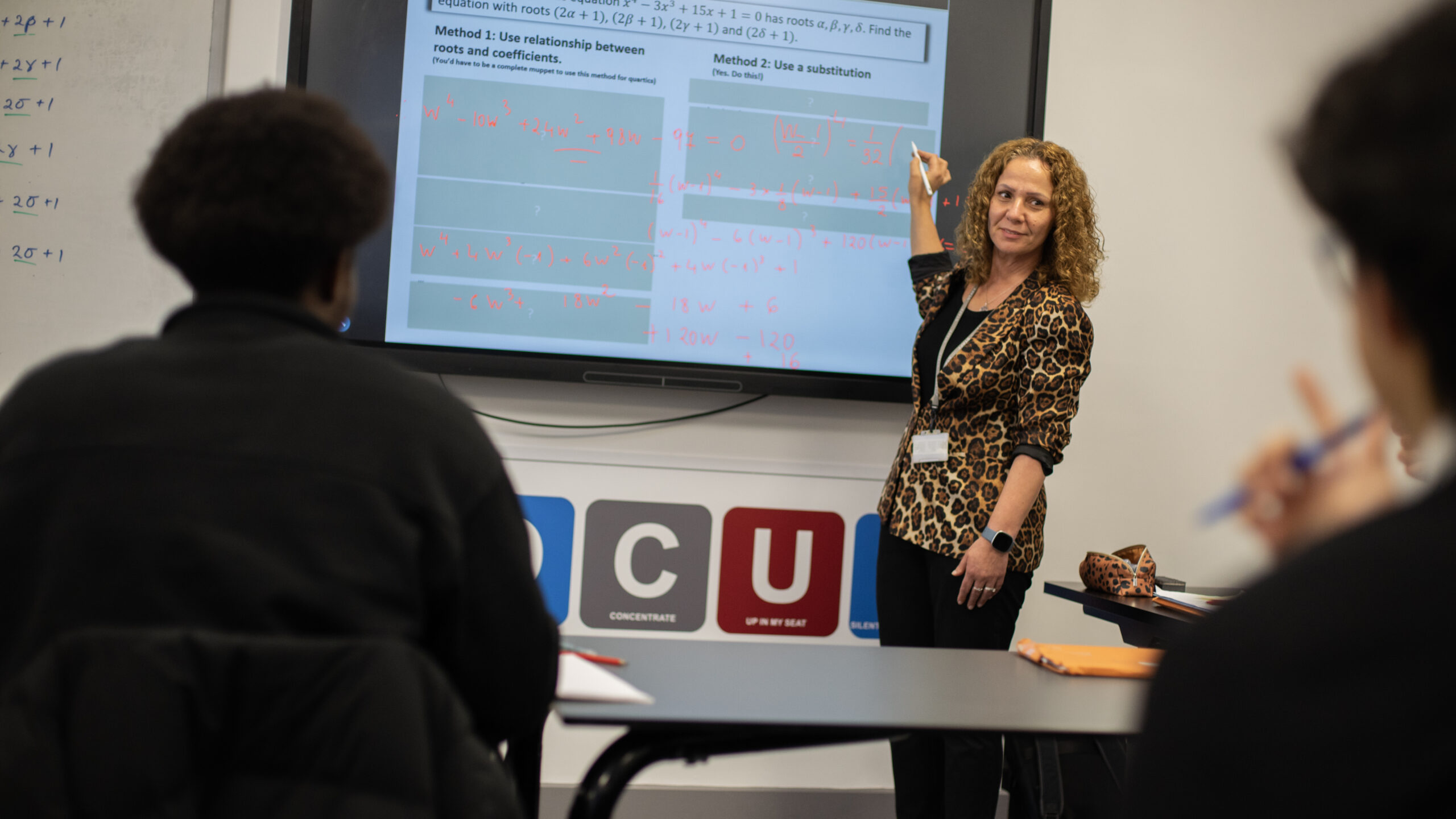
A Level Further Mathematics is studied alongside A Level Mathematics and is designed for students with exceptional mathematical ability and enthusiasm. The course extends and deepens understanding of core mathematical concepts while introducing sophisticated new areas such as complex numbers, matrices, advanced calculus and discrete mathematics.
At Hammersmith Academy, Further Mathematics represents intellectual challenge and academic ambition. Students engage with demanding problem-solving, rigorous proof, and abstract reasoning, preparing them for highly competitive university courses and mathematically intensive careers.
Through this course, we aim to:
- Build on genuine curiosity for complex and abstract mathematical ideas
- Extend students’ capacity for sophisticated analysis and multi-step problem solving
- Embed rigorous logical reasoning and confidence in constructing formal proof
- Develop intellectual resilience when tackling demanding, unfamiliar concepts
- Deepen understanding of how advanced mathematics underpins physics, engineering, economics and computer science
Year-by-Year Curriculum
Year 12
Modules include:
Module 1: Series, Roots of Polynomials and Algorithms
Students extend their understanding of algebraic structures, exploring recurrence relations and developing logical thinking through algorithmic processes.
Module 2: Graphs and Networks, Route Inspection, Matrices and Linear Transformations
This module introduces decision mathematics concepts, applying matrices and networks to solve optimisation and modelling problems.
Module 3: Travelling Salesman, Linear Programming, Proof by Induction, Discrete Random Variables and Poisson Distribution
Students develop rigorous reasoning through proof by induction while applying statistical models and optimisation techniques to real-world scenarios.
Module 4: Simplex Algorithm, Binomial Distribution and Complex Numbers
Learners explore advanced optimisation methods alongside complex number theory, strengthening algebraic fluency and abstract reasoning.
Module 5: Volumes of Revolution and Poisson Distribution
This module deepens calculus skills through applications of integration while extending understanding of probability distributions.
Module 6: Method of Differences
Students apply advanced algebraic techniques to sequences and series, refining precision in mathematical argument and structure.
Year 13
Modules include:
Module 1: Critical Path Analysis, Advanced Series and Methods in Calculus
Students model complex project networks while extending calculus techniques to solve demanding mathematical problems.
Module 2: Volumes of Revolution, Chi-Squared Tests and the Central Limit Theorem
This module combines advanced integration with statistical hypothesis testing and distribution theory.
Module 3: Polar Coordinates, Differential Equations, Probability Generating Functions and Quality of Tests
Learners explore alternative coordinate systems and advanced probability theory, applying differential equations to model change.
Module 4: Modelling with Differential Equations and Hyperbolic Functions
Students investigate mathematical modelling in dynamic systems, strengthening conceptual understanding of continuous change.
Module 5: Targeted Revision and Examination Preparation
This final module consolidates knowledge across pure, statistics and decision mathematics in preparation for A Level assessment.
Skills Gained
- Advanced conceptual understanding
- Logical reasoning and mathematical proof
- Confidence working with abstract and complex ideas
- Precision in communication and interpretation of solutions
- High-level analytical and modelling skills
Partnerships & Enrichment
Students may engage in:
- Mathematics lectures at St Paul’s Girls’ School
- University outreach events and Oxford Mathematics lectures
- Wider mathematical problem-solving competitions and extension activities

Potential Careers & Progression
Further Mathematics supports progression into highly competitive and mathematically demanding fields, including:
Actuarial Science | Aeronautical, Civil, Mechanical and Electrical Engineering | Economics | Mathematics and Statistics | Physics | Data Science and Quantitative Finance