Year 12 – 13
Politics

Key Stage: KS5

Exam Board: Edexcel

Qualification Gained: A Level Politics

Assessment Breakdown:

Entry Requirements:
Eight or more GCSEs at grades 9–4 including a minimum Grade 6 in GCSE English Language and Grade 6 in a Humanities subject.
We aim to develop active, informed citizens who understand how our political system functions, both where it succeeds and where it falls short. Students of Politics become confident, articulate debaters who can construct, defend and critique arguments with clarity, precision and insight.
A-Level Politics at Hammersmith Academy equips students with the skills to analyse complex political ideas, evaluate evidence, and form well-justified arguments. The curriculum is designed to be responsive to current events in the UK, the US and the wider world, ensuring that students continually apply political theory to real-world developments. This fosters global awareness, cultural literacy and intellectual independence.
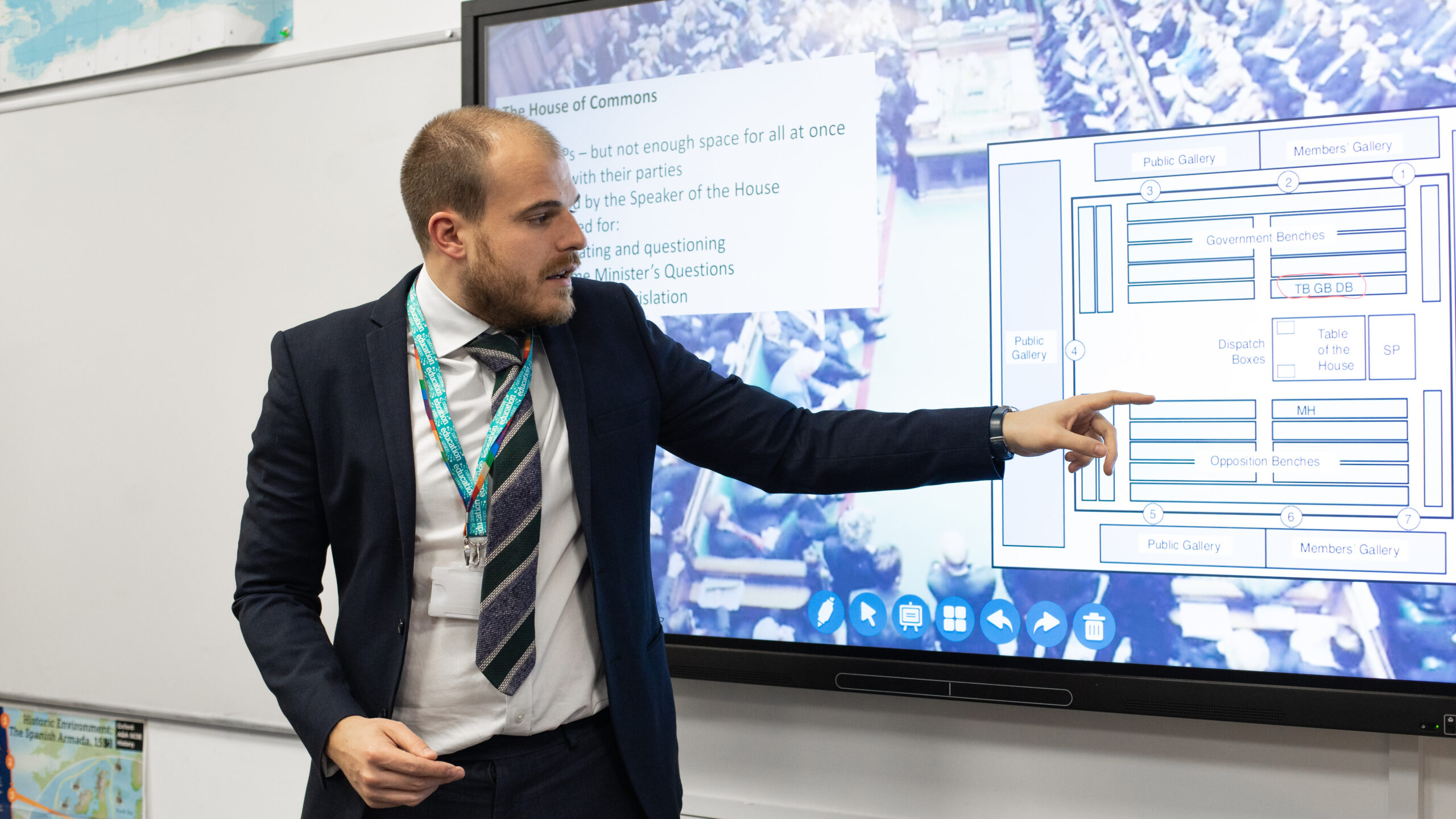
Students learn the foundations of political participation and power in the UK before studying the structure and workings of Parliament, Government, and the Prime Minister. Alongside this, the course explores the ideological roots that shape politics—Conservatism, Liberalism and Socialism—followed by Nationalism as the chosen non-core ideology due to its continued global relevance.
Edexcel has been selected for its logical structure, strong coverage of contemporary politics, and wealth of high-quality support resources (e.g. Pre-Chewed Politics and The Politics Shed). The curriculum sequence completes UK Politics and UK Government (Papers 1 & 2) by the end of Year 12, freeing Year 13 for focused study of US Politics (Paper 3) and high-level comparative analysis between the two systems.
Through debate, case study analysis, extended writing and rigorous evaluation, students gain a sophisticated understanding of how political systems operate—and why they matter.tion theory and audience theory to analyse how meaning is constructed.
Year-by-Year Curriculum
Year 12
Module 1: Foundations of UK Politics & Legitimacy
Students begin by exploring the core questions at the heart of UK democracy:
- Why do we vote?
- How are elections run and regulated?
- What gives government legitimate authority?
This module builds on introductory summer work and develops essential political vocabulary, core concepts and early essay-writing skills.
Module 2: Political Parties & UK Government
Focus shifts from the act of voting to who we vote for, examining the major UK parties—Conservatives, Labour and Liberal Democrats—alongside minor parties and the rise of Reform UK.
Students apply their understanding through contemporary case studies.
In UK Government, they complete their study of Parliament and begin examining the Executive and the role of the Prime Minister.
Module 3: Advanced UK Government & Analytical Skills
Students consolidate their understanding of how the UK political system operates, moving into more complex issues such as constitutional relationships and the balance of power.
Source analysis is introduced, requiring students to synthesise arguments and evaluate interpretations.
Module 4: Core & Non-Core Ideologies
Following mock examinations, students begin their in-depth study of political ideas:
- Conservatism
- Liberalism
- Socialism
- Nationalism (non-core ideology)
This module encourages students to engage with philosophical arguments behind political systems, challenging assumptions and developing conceptual understanding.
Module 5:
Ideology Consolidation & Exam PreparationStudents continue their study of core and non-core ideologies while revising Papers 1 and 2.
Structured feedback and targeted essay development ensure they are fully prepared for end-of-year assessments.
Year 13
Module 1: US Constitution / Democracy & Participation
Students begin Paper 3 by examining:
- The principles of the US Constitution
- Separation of powers and federalism
- Electoral systems, parties and participation in the US
Module 2: The US Presidency / The Supreme Court
This module explores executive power, presidential authority and constraints, followed by the structure, influence and ideological dynamics of the Supreme Court.
Module 3: Congress / Civil Rights
Students examine the legislative branch, its powers and limitations, and the tensions between the House and Senate.
Civil Rights movements past and present are studied, enabling powerful comparisons with UK political developments.
Module 4: Mock Exams & Targeted Revision
The spring term begins with mock examinations, followed by targeted revision based on performance.
Students build comparative arguments across UK and US politics, honing high-level evaluative and analytical skills ahead of final examinations.
Skills Gained
Students develop a sophisticated toolkit of academic and transferable skills, including:
- Critical analysis and evaluation
- Evidence selection and interpretation
- Essay writing and argument construction
- Debate, public speaking and justification of viewpoints
- Comparative political analysis
- Understanding of ideological frameworks
- Application of political theory to contemporary issues
Partnerships & Enrichment
Students benefit from:
- Engagement with current political events and case studies
- Debate and discussion forums
- Access to specialist online platforms (Pre-Chewed Politics, Politics Shed)
- Opportunities for talks, conferences and enrichment linked to UK and US politics
Potential Careers
A-Level Politics supports progression into fields such as:
Law | Public Policy | Government & Civil Service | International Relations | Journalism & Broadcasting | Political Consultancy | Campaign Strategy | Research & Think Tanks | Education | NGOs and Human Rights Organisations