Year 12 – 13
Chemistry

Key Stage: KS5

Exam Board: OCR

Qualification Gained: A Level Chemistry

Assessment Breakdown:

Entry Requirements: Eight or more GCSEs at grades 9-4 including a minimum grade 6 at GCSE in Chemistry or 6/6 in GCSE Combined Science or 5/5/6 in Triple Science (with a 6 in Chemistry). Applicants must have a grade 6 in GCSE Mathematics, and grade 6 in GCSE English Language.
To develop confident and inquisitive learners who can apply chemical knowledge to real-world contexts. The course builds strong scientific literacy, encourages curiosity about the material world, and equips students with the analytical and problem-solving skills needed to understand and explain chemical processes.
Our science curriculum follows a dynamic spiral structure that promotes deep understanding through retrieval practice, practical work and synoptic connections between topics. Students regularly revisit key concepts, allowing knowledge to be strengthened and applied in increasingly complex contexts.
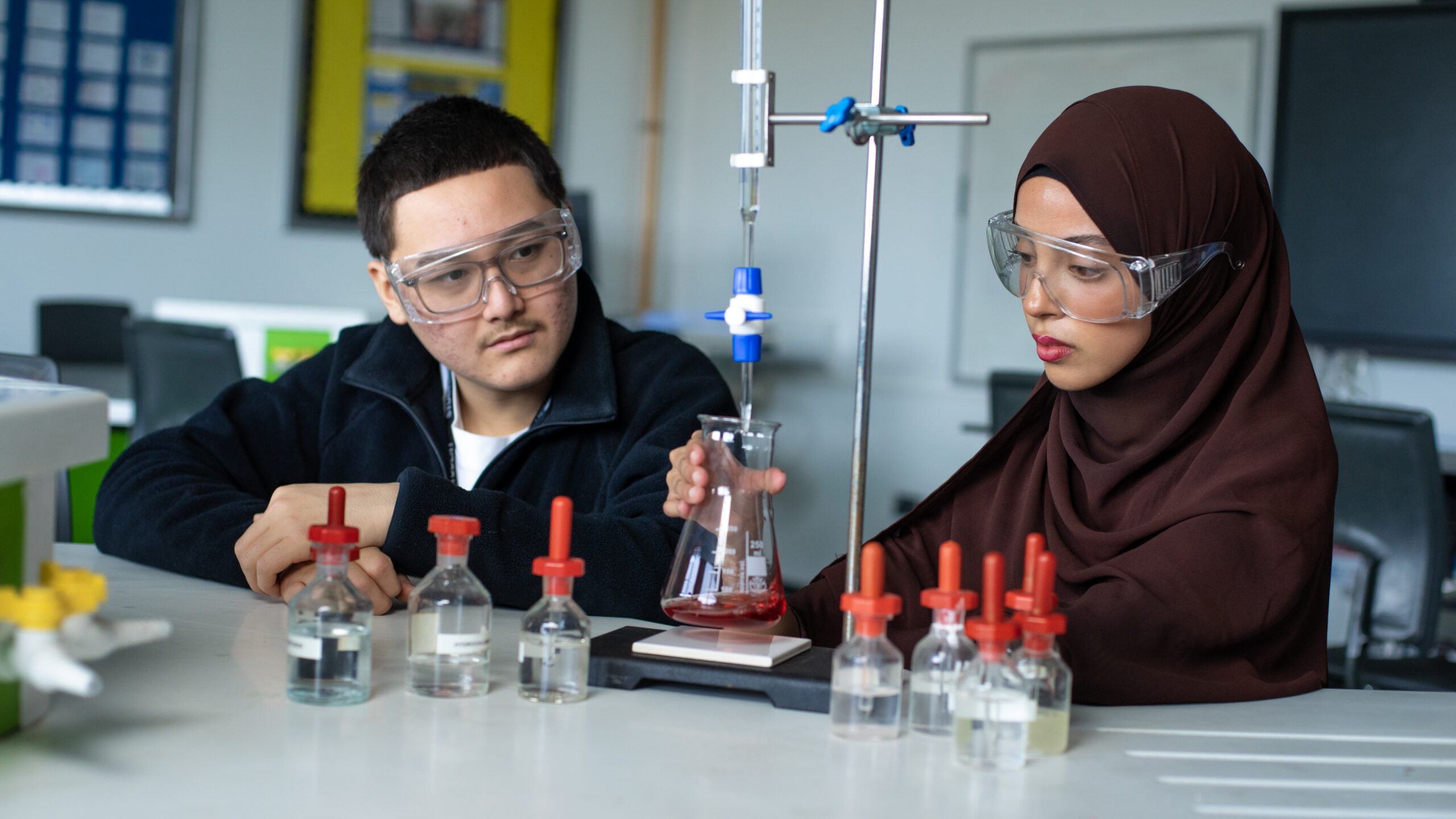
Lessons combine theoretical learning with practical investigation, enabling students to develop strong analytical and experimental skills. Scientific literacy is a central focus, with students learning to interpret data, evaluate evidence and communicate scientific ideas with clarity and precision.
The curriculum is designed to:
- Develop a secure understanding of fundamental chemical principles
- Encourage curiosity about the molecular and atomic processes that shape the world
- Build confidence in applying mathematical and analytical skills to scientific problems
- Strengthen experimental skills through regular practical investigation
- Support independent thinking and critical evaluation of scientific evidence
We follow the OCR A Level Chemistry specification because it offers an excellent balance of breadth and depth while maintaining a strong focus on conceptual understanding. Our teaching sequence builds carefully on prior knowledge so that students can develop clear conceptual frameworks and connect abstract chemical ideas across different areas of the subject.
Year-by-Year Curriculum
Year 12
Modules include:
Module 1: Atomic Structure, Redox and Bonding
Students develop an understanding of atomic structure, the periodic table and redox processes, alongside bonding and structure in chemical compounds.
Module 2: Amount of Substance and the Periodic Table
This module introduces quantitative chemistry, including moles, equations and chemical calculations, while exploring periodic trends.
Module 3: Physical Chemistry and Core Organic Chemistry
Students begin studying thermodynamics and energetics alongside the foundations of organic chemistry.
Module 4: Further Physical Chemistry and Organic Chemistry
Topics are extended through deeper exploration of chemical reactions and organic mechanisms.
Module 5: Acids
Students investigate acid-base reactions, pH and equilibrium concepts.
Module 6: Analytical Techniques and Organic Synthesis
Learner’s study key laboratory techniques used to analyse substances and synthesise organic compounds.
Year 13
Modules include:
Module 1: Acids, Bases and Buffers; Carbonyl Compounds and Analysis
Students extend their understanding of acid-base chemistry while exploring important organic functional groups and analytical techniques.
Module 2: Energy, Aromatics and Nitrogen Compounds
This unit develops knowledge of thermodynamics, aromatic chemistry and nitrogen-containing organic molecules including polymers.
Module 3: Reaction Rates, Transition Elements and Organic Synthesis
Students examine chemical kinetics, transition metal chemistry and complex organic synthesis pathways.
Modules 4–5: Revision and Examination Preparation
Knowledge from across the course is consolidated through targeted practice and synoptic problem solving.
Skills Gained
Students develop the ability to:
- Plan, carry out, analyse and evaluate scientific investigations
- Critically evaluate evidence from scientific sources
- Apply mathematical and problem-solving skills in scientific contexts
- Use precise scientific language to explain complex ideas
Potential Careers & Progression
A Level Chemistry provides a strong foundation for careers in:
Medicine and Dentistry | Pharmacy and Pharmaceutical Science | Engineering | Education and Science Communication | Law and Patent Science