Year 12 – 13
History

Key Stage: KS5

Exam Board: Edexcel

Qualification Gained: A Level History

Assessment Breakdown:
The Edexcel A Level History course is assessed through two written examinations and one coursework component:
- Paper 1: Breadth Study (40%) – Assessed through essays and source analysis; focuses on Tsarist and Communist Russia, 1855–1964.
- Paper 2: Depth Study (40%) – Assessed through structured and thematic essays; covers The British Empire, c1857–1967.
- Non-Exam Assessment (20%) – An independent coursework assignment of approximately 3,000–3,500 words, exploring a student-chosen topic linked to historical interpretation and debate.

Entry Requirements:
Students must have achieved eight or more GCSEs at grades 9–4, including a minimum of Grade 6 in English Language and Grade 6 in History.
History at Hammersmith Academy develops a lifelong curiosity about the past and its influence on the present. The course inspires students to question, analyse and interpret historical events, encouraging them to form their own evidence-based arguments about the forces that have shaped our world. Our vision is to guide students toward the two key outcomes of History — understanding where they have come from and where they could go — while cultivating critical thinkers who can articulate complex ideas with confidence.
At Hammersmith Academy, we deliver a culturally rich, contextually relevant and high-skilled History curriculum that equips students with an understanding of how both British and global histories continue to shape modern life.
By the end of Key Stage 5, students will have mastered key historical concepts such as cause and consequence, change and continuity, and similarity and difference, applying these to comparative studies across different eras and societies. Lessons immerse students in the craft of historical enquiry, exposing them to a broad range of sources and interpretations from the outset and helping them develop the analytical rigour of professional historians.
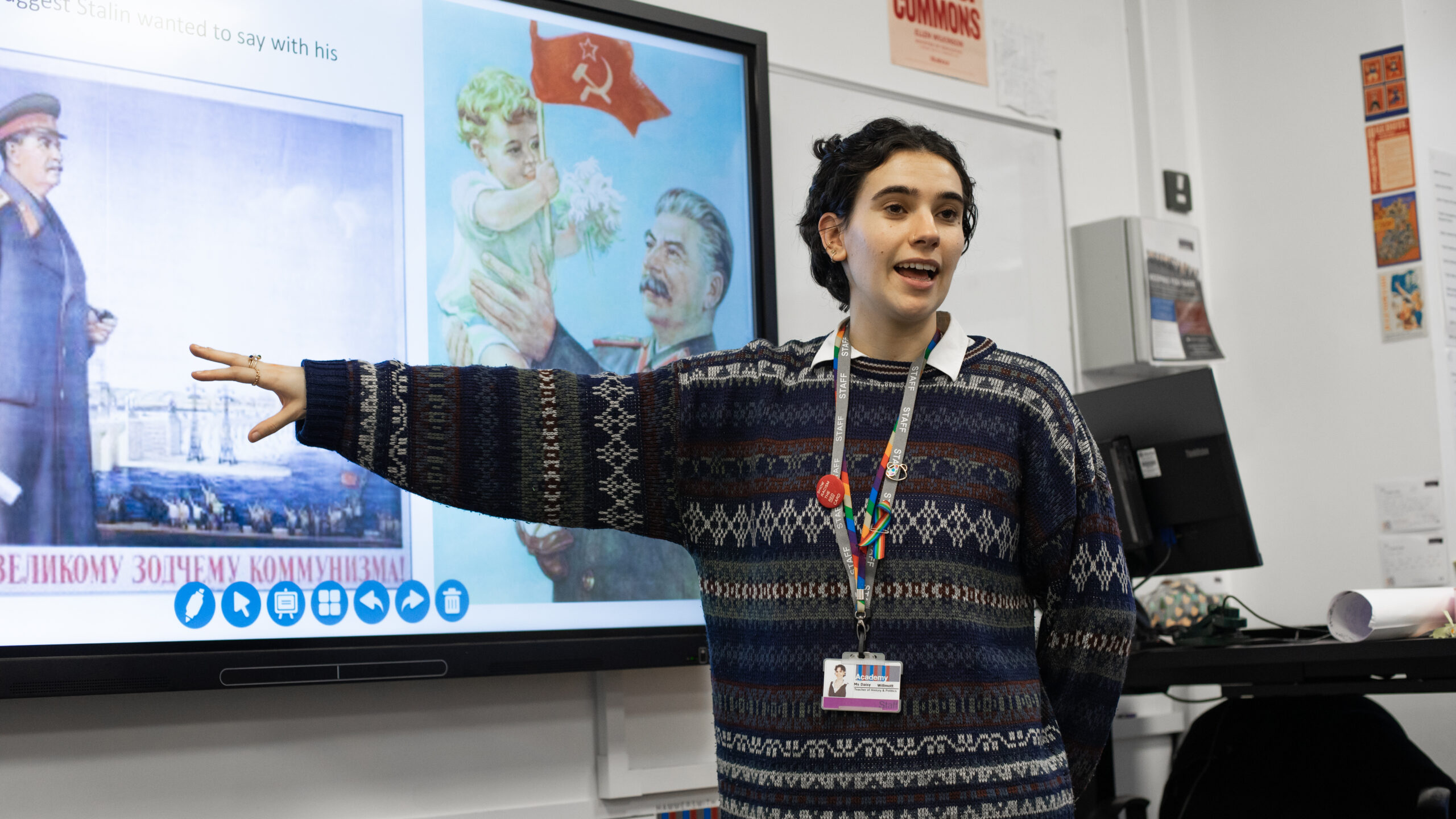
The selection of A Level topics at Hammersmith Academy reflects our commitment to developing cultural capital and global awareness. Students explore Tsarist and Communist Russia (1855–1964), gaining insight into how revolution and ideology reshaped society. The Russian Revolutions of 1917, the rise of Stalinism and the pursuit of rapid industrialisation remain profoundly relevant today, raising enduring questions about power, progress and human cost.
The British Empire (1857–1967) module complements this by examining Britain’s expansion, administration and decline as a global power. It challenges students to evaluate political and moral legacies that continue to influence modern Britain, from economics to multiculturalism.
In addition to the examined components, students complete a coursework investigation on a self-selected topic, with the Crusades recommended as a popular and resource-rich option. This independent project fosters academic independence, research skills and essay writing proficiency — key preparation for university-level study.
Across both years, the course combines historical knowledge with critical discussion, helping students become confident thinkers capable of constructing balanced, well-supported arguments.
Year-by-Year Curriculum
Year 12
Students explore political, social and economic change in Russia and the early development of the British Empire while beginning independent coursework research.
Modules include:
- 1917 / 1857–1890: India and the Scramble for Africa (Module 1)
- Bolshevik Consolidation (Module 2)
- Stalin’s Rise to Power (Module 3)
- Coursework Research and Writing (Modules 4–5)
- Revision (Module 6)
Year 13
Students focus on the later Russian and British studies, examining the complexities of empire, Stalinism and the Second World War, while refining coursework and preparing for final exams.
Modules include:
- Economy and Society (Module 1)
- Stalinism, Politics and Control (Module 2)
- The Great Patriotic War (Module 3)
- Revision (Modules 4–5)
- Study Leave (Module 6)
This two-year structure provides a strong balance between guided teaching and independent research, equipping students with confidence, discipline and intellectual curiosity.
Skills Gained
- Critical thinking and analytical reasoning
- Research and independent learning
- Evaluation and interpretation of sources
- Argument construction and extended writing
- Communication of complex ideas
- Organisation and self-discipline
These skills prepare students for success at university and in professional environments where analysis, persuasion and independent judgement are essential.
Partnerships & Enrichment
Students enhance their studies through enrichment opportunities and partnerships with leading cultural and historical institutions, including:
- The National Archives
- Imperial War Museum
These experiences provide access to primary research materials and expert insights, helping students engage with history as a living, evolving discipline.

Potential Careers & Progression
A Level History provides an excellent foundation for higher education and careers in:
Research (archaeologist, policy researcher, data analyst)
Cultural sector (museum curator, archivist, charity or heritage manager)
Information and communication (librarian, journalist, think tank analyst)
Education (teacher, heritage interpretation guide)
Conservation and heritage (auctioneer, restoration specialist)
Government and politics (civil service, parliamentary research, local authority)
NGOs and international development (human rights, environmental policy, humanitarian work)
These pathways value the historian’s ability to think critically, evaluate evidence, and communicate complex ideas with clarity.