Year 12 – 13
Mathematics

Key Stage: KS5

Exam Board: Edexcel

Qualification Gained: A Level Mathematics

Assessment Breakdown:

Entry Requirements: Students must achieve a grade 7 in GCSE Mathematics in order to study this course.
We aim to develop confident, independent learners who achieve their full academic potential and grow their appreciation for the language, beauty and wide-ranging applications of Mathematics. Maths helps us understand and explain the world—supporting financial planning, interpreting information and modelling real-life situations—and underpins fields such as finance, engineering and computer science.
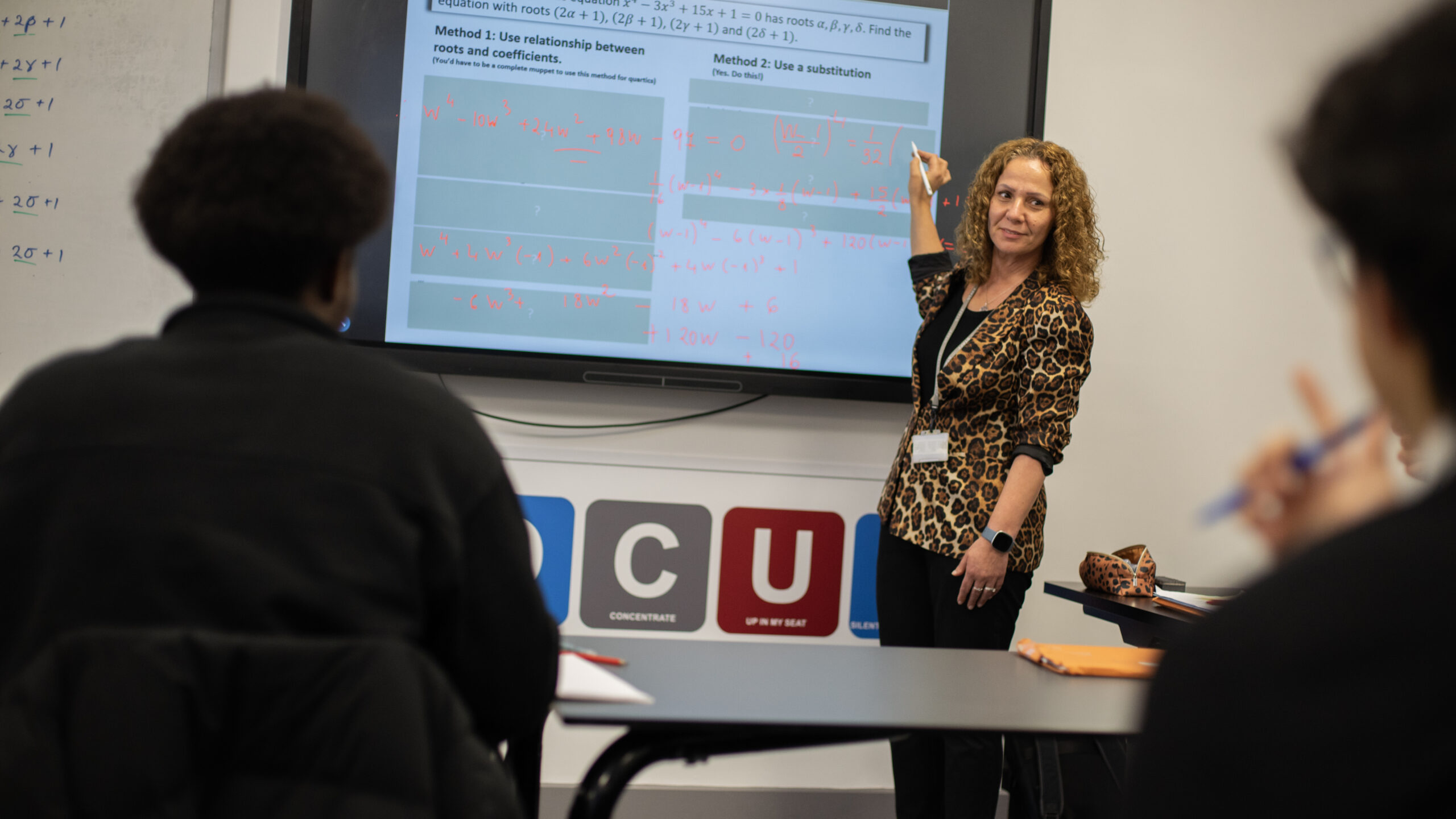
At Key Stage 5, Mathematics at Hammersmith Academy offers a challenging, rewarding course that prepares students for further study and employment while developing them as resilient, reflective thinkers. Students take increased responsibility for progress through independent study and completing exam-question packs
Following the Pearson Edexcel A-Level Mathematics specification, our curriculum is designed to:
- Promote confidence and enjoyment by engaging deeply with ideas and seeing Mathematics as a tool for understanding and shaping the world (most topics include modelling applications).
- Develop advanced fluency across Pure Mathematics, Statistics and Mechanics, with independent practice supported by targeted exam packs.
- Strengthen reasoning and proof, enabling students to construct logical arguments and solve complex problems in varied contexts.
Highlight connections across mathematical domains and real-world applications, showcased through student “Maths in Context” presentations.
Year-by-Year Curriculum
Year 12
Module 1: Algebra, Lines, Curves & Trigonometry
- Revise GCSE algebra (indices, expanding/factorising, surds, rationalising) via a baseline and independent home tasks.
- Solve quadratics (factorising, formula, completing the square); use the discriminant and graph features for modelling.
- Inequalities (linear/quadratic), transformations of functions; cubic, quartic and reciprocal graphs.
- Trigonometry: sine/cosine rules, triangle area, graph interpretation and transformations.
- Coordinate geometry: gradients, straight-line forms, parallels/perpendiculars, midpoints and perpendicular bisectors.
- Circles: equation, intersections with lines, tangents and chords.
- Mechanics introduction: modelling assumptions; scalars vs vectors; representing vectors for magnitude/direction.
Module 2: Trigonometry in Degrees & Radians, Intro to Statistics, Differentiation
- Degrees ↔ radians; arc length and sector area; exact values; identities; multi-angle equations; small-angle approximations.
- Statistics: populations vs samples; sampling methods; Large Data Set; types of data; measures of location and spread (including coding), variance and standard deviation.
- Kinematics graphs (distance–time, velocity–time); suvat for constant acceleration; gravity in vertical motion.
- Differentiation basics: gradients of tangents/normals; increasing/decreasing functions; second derivative and stationary points; modelling with rates of change.
Module 3: Graphical Representations, Probability, Integration, Forces
- Statistics visuals: box plots, cumulative frequency, histograms; compare distributions; correlation and linear regression.
- Probability from tables/lists; Venn diagrams; independence/mutual exclusivity; tree diagrams for multi-stage problems.
- Integration of powers of x (indefinite/definite); areas under/ between curves; find functions from derivatives.
- Vectors in geometry and simple models; force diagrams; Newton’s laws; 2D acceleration and motion; connected particles and pulleys.
Module 4: Probability Distributions, Hypothesis Testing, Calculus in Mechanics, Binomial Expansion
- Binomial expansion via Pascal/factorials; applications to integer, negative and fractional powers and estimation.
- Binomial distribution; cumulative probabilities; one- and two-tailed hypothesis tests using critical values.
- Calculus in mechanics: velocity/acceleration from differentiation; displacement from integration; max/min motion problems; constant-acceleration applications.
Year 13
Module 1: Trigonometry & Differentiation (Advanced) | 3D Vectors & Applied Rates
- Trig: reciprocal functions (sec, cosec, cot), inverse trig, addition/double-angle formulae, solving over intervals, rewriting acosx+bsinxa\cos x + b\sin xacosx+bsinx, proofs and modelling.
- Differentiation: chain/product/quotient rules; trig/exponential/log functions; implicit differentiation; second derivative for curve shape; applied rates of change.
- 3D coordinates & vectors for geometric problems and mechanics (particle motion and forces in space).
Module 2: Integration Techniques, Functions & Moments
- Integration techniques: trig identities, reverse chain rule, substitution, integration by parts, partial fractions.
- Areas under curves, trapezium rule, differential equations for growth/decay and motion modelling.
- Functions: modulus, composite and inverse functions; solving modulus equations; sketching transformations.
- Mechanics: moments, resultant moments, equilibrium conditions, centre of mass and tilting/ stability.
Module 3: Parametric Equations | Correlation & Probability | Friction, Projectiles & Connected Particles
- Parametric curves: sketching, intersections, modelling motion; differentiate/integrate parametrics.
- Statistics: exponential models; correlation; hypothesis testing; conditional probability with Venns/trees/formulae.
- Mechanics: resolving forces (including on inclines), friction and resistance; projectile motion (horizontal and angled); statics of particles/rigid bodies; connected particles and pulleys; dynamics on slopes.
Module 4: Normal Distribution, Proof, Variable Acceleration, Sequences & Numerical Methods
- Normal distribution: probabilities, inverse normal, standard normal; find μ/σ from probabilities; binomial ≈ normal; hypothesis testing with the normal.
- Proof: direct methods and proof by contradiction.
- Mechanics with vectors: variable acceleration in 1D/2D; velocity/displacement/acceleration via differentiation/integration.
- Sequences & series: arithmetic/geometric (including sum to infinity), sigma notation, recurrence relations, modelling with series.
- Numerical methods: locating roots by iteration and Newton–Raphson.
Module 5: Revision & Examinations
- Synoptic practice, interleaving of topics and challenging exam questions under timed conditions; teacher-led modelling and targeted reteach of priority areas.
Skills Gained
- Advanced algebraic fluency and calculus
- Mathematical reasoning, modelling and proof
- Statistical analysis, data interpretation and hypothesis testing
- Vector methods and mechanics problem-solving
- Resilience, independence and effective exam technique
- Communication of complex ideas with precise mathematical language
Partnerships & Enrichment
- “Maths in Context” presentations to connect theory and applications
- Structured independent study with exam-question packs
Potential Careers
A-Level Maths provides an excellent foundation for careers such as:
Engineering | Physical Sciences | Computing & AI | Finance | Accounting | Economics & Data Science | Architecture | Medicine | Psychology (quantitative pathways) | Research | Analytics and a wide range of STEM fields