Year 12 – 13
Physics

Key Stage: KS5

Exam Board: OCR

Qualification Gained: A Level Physics

Assessment Breakdown: The OCR A Level Physics course is assessed through three written examinations and a practical endorsement:
- Paper 1: Modelling Physics (37%) – Covers foundations of physics, forces, motion, materials, and electricity.
- Paper 2: Exploring Physics (37%) – Focuses on waves, quantum physics, thermal physics, and fields.
- Paper 3: Unified Physics (26%) – Synoptic assessment integrating all areas of the specification.
- Practical Endorsement (Non-Examined) – Assessment of experimental and investigative skills through 12 core practical’s conducted across the course.
These components ensure that students develop both theoretical mastery and hands-on scientific competence.

Entry Requirements: Students must have achieved eight or more GCSEs at grades 9–4, including:
- A minimum grade 6 in GCSE Physics, or 6/6 in Combined Science, or 5/5/6 in Triple Science (with a 6 in Physics).
- Grade 6 in GCSE Mathematics.
- Grade 6 in GCSE English Language.
Physics at Hammersmith Academy develops confident, curious scientists who explore how the universe works — from the subatomic to the cosmic. The course inspires students to understand how Physics shapes modern civilisation, encouraging critical thinking, problem-solving and analytical reasoning through engaging, rigorous learning experiences.
Our A Level Physics curriculum is designed to spark a deep curiosity about the physical world while developing the precision and discipline essential to scientific study. Through a combination of theoretical exploration, experimentation and real-world application, students gain the ability to analyse complex systems and explain the principles that underpin them.
Lessons are structured to promote independent learning, collaborative investigation, and extended problem-solving, helping students transition effectively from guided learning at GCSE to self-directed study at Key Stage 5. The course integrates mathematical fluency with conceptual understanding, ensuring students can apply physics in diverse contexts — from everyday technology to cutting-edge research.
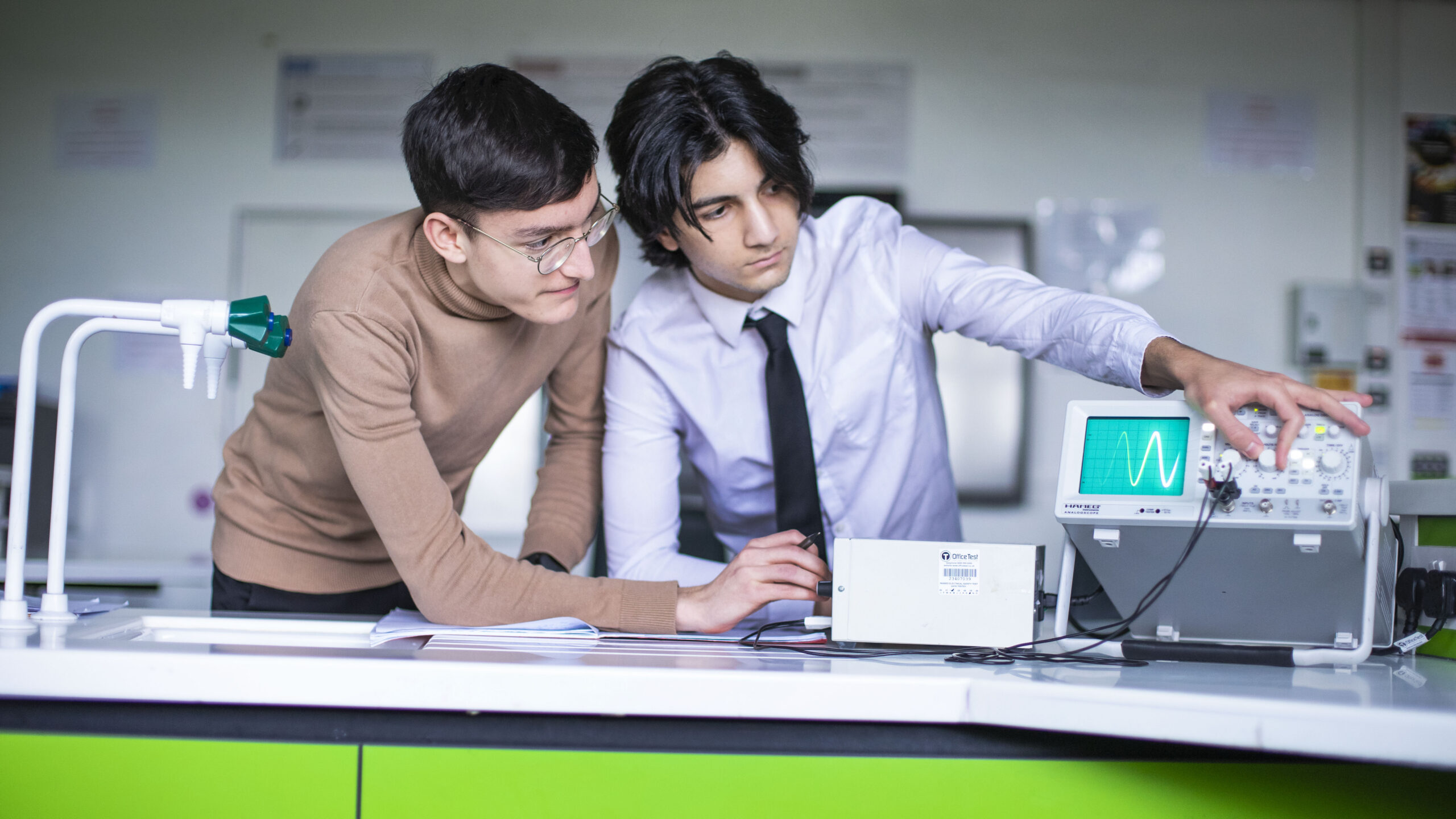
Practical work is central to the course. Students complete 12 core practicals that meet the OCR Practical Endorsement standards, developing precision, reliability and a systematic approach to experimentation. Each practical is tracked and assessed to ensure students meet the required competencies for higher education and industry readiness.
Beyond the classroom, enrichment opportunities — including visits, guest lectures and trips such as to CERN in Switzerland — connect theoretical knowledge to the frontiers of modern science. These experiences highlight Physics as a subject of creativity, innovation and imagination.
Year-by-Year Curriculum
Year 12
Students explore core concepts that form the foundation of physics, from motion and energy to electricity and waves.
Modules include:
- Foundations of Physics, Motion Introduction, Forces Part 1, Electricity Part 1 (Current), Work, Energy & Power, Waves Part 1 (Module 1)
- Materials Part 1, Motion Part 2, Waves Part II, Electricity Part II (Module 2)
- Laws of Motion and Momentum, Electricity Part III, Circular Motion, Forces in Action Part II (Module 3)
- Waves Part III, Electricity Part IV, Thermal Physics, Quantum Physics (Module 4)
- Medical Imaging, Oscillations, Ideal Gases, Young’s Modulus (Module 5)
- Stars, Gravitational Fields (Module 6)
Students build confidence in experimentation and quantitative reasoning, learning how to collect and evaluate data effectively.
Year 13
Students extend their understanding to advanced fields of physics, integrating previous knowledge with new theoretical and practical applications.
Modules include:
- Particle Physics, Capacitors, Radioactivity (Module 1)
- Cosmology, Electric Fields, Nuclear Physics, Magnetic Fields (Module 2)
- Revision (Module 3)
- Revision (Module 4)
- Revision (Module 5)
- Study Leave (Module 6)
This final year develops higher-order thinking and mathematical modelling skills, preparing students for university-level study or scientific careers.
Skills Gained
- Problem solving and analytical reasoning
- Data handling and statistical interpretation
- Experimental planning and evaluation
- Logical communication and scientific writing
- Mathematical fluency and quantitative analysis
- Independent research and collaboration
These skills are highly transferable, preparing students for both STEM degrees and careers requiring precision, creativity and analytical thinking.
Partnerships & Enrichment
Students have opportunities to connect theory to practice through enrichment experiences, such as:
- CERN, Switzerland Trip
These experiences inspire students to see science as a global, creative and ever-evolving discipline.
Potential Careers & Progression
A Level Physics provides a strong foundation for university courses and careers in:
Aerospace and Defence | Engineering and Manufacturing | Energy and Renewable Resources | Medicine and Medical Physics | Nanotechnology and Materials Science | Telecommunications and Information Technology | Meteorology and Climate Science | Scientific Research and Education